


In the high-stakes world of financial technology, clarity is currency. When designing a Mutual Fund Investment System, architects must navigate complex relationships between investors, fund types, transaction histories, and performance metrics. A static class diagram serves as the blueprint for this domain, mapping out the structural integrity of the software before a single line of business logic is written.

This tutorial guides you through constructing a professional-grade Mutual Fund Investment System class diagram using PlantUML and VPasCode. By utilizing a diagram-as-code approach, we ensure that the model remains versionable, readable, and instantly renderable. VPasCode provides a free, browser-based environment where you can prototype these financial architectures with zero setup, allowing you to focus on the domain logic rather than tool configuration.
Understanding the Model: Purpose, Scope & Problem Framing
Diagram Abstraction & Representation
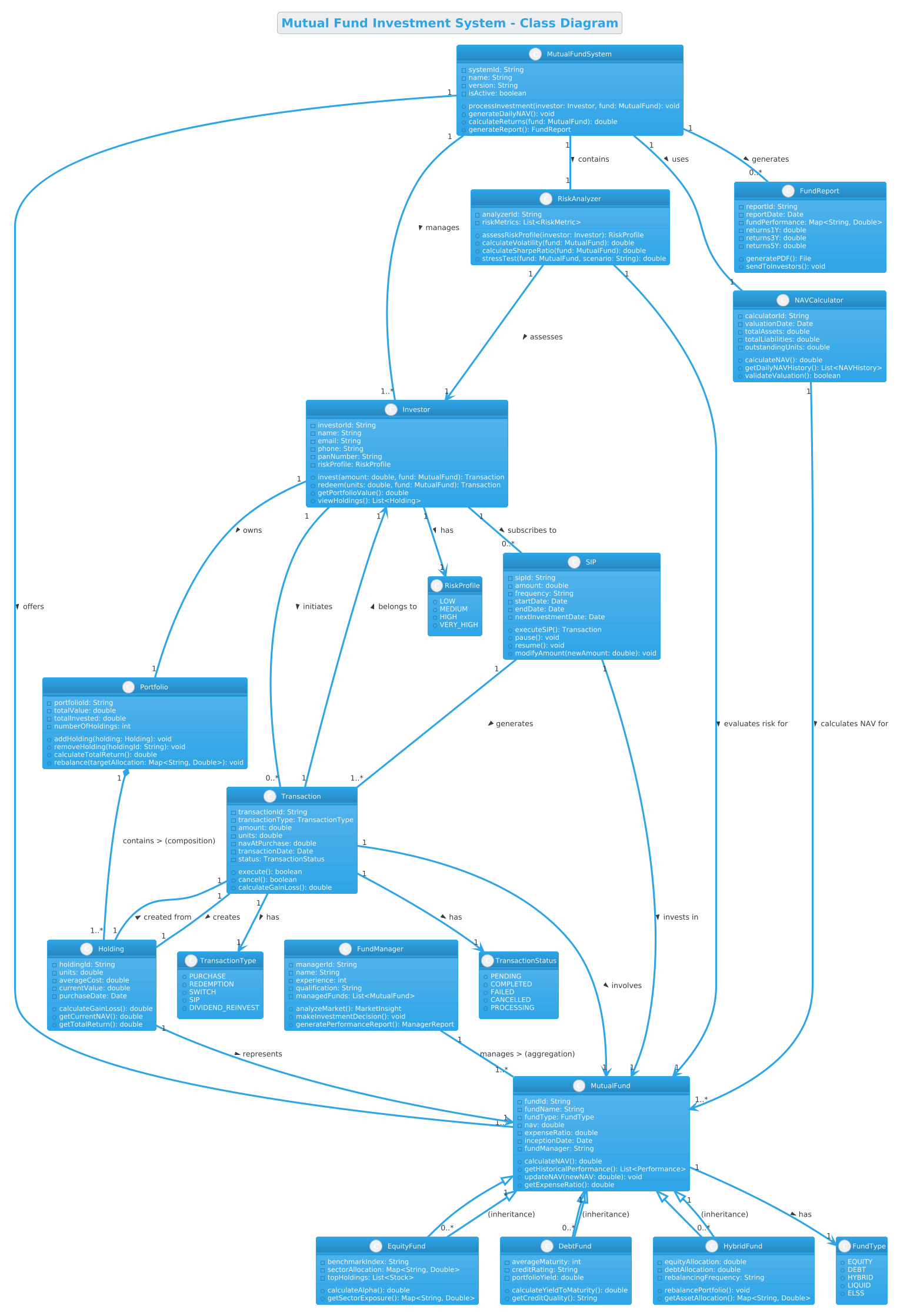
A Class Diagram is the primary tool for modeling the static structure of a system. In the context of finance, it defines the entities (like Investor or MutualFund), their attributes (like nav or panNumber), and their behaviors (like invest or calculateNAV). It also visualizes the cardinality and multiplicity of relationships, ensuring that the system enforces business rules—such as an Investor owning a Portfolio, or a Portfolio containing Holdings.
Target Domain Scope & Scenario
This model focuses on the core operational engine of a mutual fund platform. It intentionally excludes external integrations like payment gateways or regulatory reporting APIs to keep the diagram focused on the internal domain model. The scope covers:
- Investor Management: Profiles, risk assessments, and portfolio tracking.
- Fund Management: The hierarchy of funds (Equity, Debt, Hybrid) and NAV calculations.
- Transaction Processing: The lifecycle of investments, redemptions, and SIPs.
Key Takeaways & Educational Insights
By following this guide, you will learn how to model complex financial hierarchies using inheritance (e.g., EquityFund extending MutualFund), manage state transitions via composition (e.g., Portfolio containing Holdings), and define clear associations between system actors and data entities.
Complete Diagram & Full Source Code
Below is the complete, finalized class diagram for the Mutual Fund Investment System. You can view the rendered output directly in the VPasCode editor.
@startuml
!theme cerulean
title Mutual Fund Investment System - Class Diagram

' Core classes
class MutualFundSystem {
  - systemId: String
  - name: String
  - version: String
  - isActive: boolean
  + processInvestment(investor: Investor, fund: MutualFund): void
  + generateDailyNAV(): void
  + calculateReturns(fund: MutualFund): double
  + generateReport(): FundReport
}

class Investor {
  - investorId: String
  - name: String
  - email: String
  - phone: String
  - panNumber: String
  - riskProfile: RiskProfile
  + invest(amount: double, fund: MutualFund): Transaction
  + redeem(units: double, fund: MutualFund): Transaction
  + getPortfolioValue(): double
  + viewHoldings(): List<Holding>
}

class MutualFund {
  - fundId: String
  - fundName: String
  - fundType: FundType
  - nav: double
  - expenseRatio: double
  - inceptionDate: Date
  - fundManager: String
  + calculateNAV(): double
  + getHistoricalPerformance(): List<Performance>
  + updateNAV(newNAV: double): void
  + getExpenseRatio(): double
}

class EquityFund extends MutualFund {
  - benchmarkIndex: String
  - sectorAllocation: Map<String, Double>
  - topHoldings: List<Stock>
  + calculateAlpha(): double
  + getSectorExposure(): Map<String, Double>
}

class DebtFund extends MutualFund {
  - averageMaturity: int
  - creditRating: String
  - portfolioYield: double
  + calculateYieldToMaturity(): double
  + getCreditQuality(): String
}

class HybridFund extends MutualFund {
  - equityAllocation: double
  - debtAllocation: double
  - rebalancingFrequency: String
  + rebalancePortfolio(): void
  + getAssetAllocation(): Map<String, Double>
}

class Transaction {
  - transactionId: String
  - transactionType: TransactionType
  - amount: double
  - units: double
  - navAtPurchase: double
  - transactionDate: Date
  - status: TransactionStatus
  + execute(): boolean
  + cancel(): boolean
  + calculateGainLoss(): double
}

class Holding {
  - holdingId: String
  - units: double
  - averageCost: double
  - currentValue: double
  - purchaseDate: Date
  + calculateGainLoss(): double
  + getCurrentNAV(): double
  + getTotalReturn(): double
}

class Portfolio {
  - portfolioId: String
  - totalValue: double
  - totalInvested: double
  - numberOfHoldings: int
  + addHolding(holding: Holding): void
  + removeHolding(holdingId: String): void
  + calculateTotalReturn(): double
  + rebalance(targetAllocation: Map<String, Double>): void
}

class FundManager {
  - managerId: String
  - name: String
  - experience: int
  - qualification: String
  - managedFunds: List<MutualFund>
  + analyzeMarket(): MarketInsight
  + makeInvestmentDecision(): void
  + generatePerformanceReport(): ManagerReport
}

class NAVCalculator {
  - calculatorId: String
  - valuationDate: Date
  - totalAssets: double
  - totalLiabilities: double
  - outstandingUnits: double
  + calculateNAV(): double
  + getDailyNAVHistory(): List<NAVHistory>
  + validateValuation(): boolean
}

class RiskAnalyzer {
  - analyzerId: String
  - riskMetrics: List<RiskMetric>
  + assessRiskProfile(investor: Investor): RiskProfile
  + calculateVolatility(fund: MutualFund): double
  + calculateSharpeRatio(fund: MutualFund): double
  + stressTest(fund: MutualFund, scenario: String): double
}

' Relationships
MutualFundSystem "1" -- "1..*" Investor : manages >
MutualFundSystem "1" -- "1..*" MutualFund : offers >
MutualFundSystem "1" -- "1" NAVCalculator : uses >
MutualFundSystem "1" -- "1" RiskAnalyzer : contains >

Investor "1" -- "1" Portfolio : owns >
Investor "1" -- "0..*" Transaction : initiates >

Portfolio "1" *-- "1..*" Holding : contains > (composition)

Holding "1" --> "1" MutualFund : represents >
Holding "1" -- "1" Transaction : created from >

MutualFund "1" <|-- "0..*" EquityFund : (inheritance)
MutualFund "1" <|-- "0..*" DebtFund : (inheritance)
MutualFund "1" <|-- "0..*" HybridFund : (inheritance)

FundManager "1" -- "1..*" MutualFund : manages > (aggregation)

NAVCalculator "1" --> "1..*" MutualFund : calculates NAV for >
RiskAnalyzer "1" --> "1" Investor : assesses >
RiskAnalyzer "1" --> "1" MutualFund : evaluates risk for >

Transaction "1" --> "1" MutualFund : involves >
Transaction "1" --> "1" Investor : belongs to >
Transaction "1" -- "1" Holding : creates >

' Supporting types
class RiskProfile {
  + LOW
  + MEDIUM
  + HIGH
  + VERY_HIGH
}

class FundType {
  + EQUITY
  + DEBT
  + HYBRID
  + LIQUID
  + ELSS
}

class TransactionType {
  + PURCHASE
  + REDEMPTION
  + SWITCH
  + SIP
  + DIVIDEND_REINVEST
}

class TransactionStatus {
  + PENDING
  + COMPLETED
  + FAILED
  + CANCELLED
  + PROCESSING
}

' Type relationships
Investor "1" --> "1" RiskProfile : has >
MutualFund "1" --> "1" FundType : has >
Transaction "1" --> "1" TransactionType : has >
Transaction "1" --> "1" TransactionStatus : has >

' Additional classes
class SIP {
  - sipId: String
  - amount: double
  - frequency: String
  - startDate: Date
  - endDate: Date
  - nextInvestmentDate: Date
  + executeSIP(): Transaction
  + pause(): void
  + resume(): void
  + modifyAmount(newAmount: double): void
}

Investor "1" -- "0..*" SIP : subscribes to >
SIP "1" --> "1" MutualFund : invests in >
SIP "1" -- "1..*" Transaction : generates >

class FundReport {
  - reportId: String
  - reportDate: Date
  - fundPerformance: Map<String, Double>
  - returns1Y: double
  - returns3Y: double
  - returns5Y: double
  + generatePDF(): File
  + sendToInvestors(): void
}

MutualFundSystem "1" -- "0..*" FundReport : generates >

@endumlStep-by-Step Architectural Walkthrough
Phase 1: Canvas Configuration & Layout Directives
Every PlantUML diagram begins with setup directives that define the visual theme and layout. In this financial model, we use the cerulean theme to provide a clean, professional blue-toned aesthetic suitable for enterprise documentation.
We also declare the diagram type and title immediately to ensure the renderer knows how to interpret the subsequent code.
@startuml
!theme cerulean
title Mutual Fund Investment System - Class Diagram
Phase 2: Declaring Core Entities, Actors, and Boundaries
The backbone of the system consists of the MutualFundSystem class, which acts as the central controller. We define its attributes (like systemId) and public methods (like processInvestment). Similarly, the Investor class captures personal details and risk profiles.
In VPasCode, you can type these classes directly, and the live preview will instantly render the boxes. Notice the use of the - prefix for private attributes and + for public methods, adhering to standard UML visibility conventions.
class Investor {
  - investorId: String
  - name: String
  - email: String
  + invest(amount: double, fund: MutualFund): Transaction
}
Phase 3: Mapping Data Flows & Key Interactions
Once the classes are defined, we establish relationships using association lines. For example, an Investor owns exactly one Portfolio, but a Portfolio contains many Holdings. We use the "1" -- "1..*" syntax to denote this one-to-many cardinality.
Composition is critical here. The Portfolio *owns* the Holdings, meaning if the Portfolio is deleted, the Holdings should logically be removed. We represent this with a filled diamond:
Portfolio "1" *-- "1..*" Holding : contains > (composition)Phase 4: Grouping, Annotations & Visual Polish
Finally, we handle inheritance and supporting types. The financial domain relies heavily on categorization. We define EquityFund, DebtFund, and HybridFund as subclasses of MutualFund using the <|-- notation. This creates a clear visual hierarchy, showing that all specific funds share the core properties of the parent class.
MutualFund "1" <|-- "0..*" EquityFund : (inheritance)Syntax & Keyword Deep Dive
To master PlantUML in VPasCode, you must understand the specific connectors used to map financial logic:
class: Defines a new entity with attributes and methods.extends: Used within class definitions to denote inheritance (e.g.,class EquityFund extends MutualFund).--: Represents a standard association (a relationship between two classes).*--: Represents composition (strong ownership; e.g.,PortfoliocontainsHoldings).<|--: Represents generalization or inheritance (e.g.,EquityFundis a type ofMutualFund)."1" -- "0..*": Specifies cardinality.1means exactly one,0..*means zero or many.
Best Practices & Pitfalls to Avoid
- Maintain Separation of Concerns: Keep domain entities (like
Investor) separate from system controllers (likeMutualFundSystem). Do not mix business logic with infrastructure details in the same class. - Use Consistent Naming: Always use PascalCase for class names and camelCase for attributes. This improves readability significantly in VPasCode previews.
- Avoid Over-Engineering: Start with the core relationships (Investor-Portfolio-Fund). Add complex attributes like
topHoldingsorbenchmarkIndexonly when the diagram scope requires them. - Leverage Themes: Use
!themedirectives to ensure your diagrams look professional immediately. Theceruleantheme is excellent for financial systems.
Start Building PlantUML Diagrams Faster with VPasCode
Instantly render your Mutual Fund Investment System class diagram online with zero installation. Test syntax, customize themes, and share your financial architecture instantly.