


In the fast-paced world of logistics and media distribution, the efficiency of the final mile is often the difference between a satisfied subscriber and a lost revenue stream. For newspaper publishers managing print edition circulation, the operational complexity is immense: coordinating thousands of drop points, assigning dynamic routes to carriers, and ensuring every single copy reaches its intended recipient. Without a precise data model, tracking delivery exceptions, managing carrier performance, and verifying subscriber receipt becomes a chaotic administrative burden. Visualizing this intricate ecosystem requires more than just a list of spreadsheets; it demands a clear, structured blueprint of how entities like carriers, routes, and subscribers interact.

This is where diagramming-as-code, specifically using PlantUML, transforms the workflow. By modeling the backend data structure for a circulation management system, architects can proactively identify relationship bottlenecks, enforce data integrity rules, and document the verification logic required to resolve delivery disputes. In this masterclass, we will build a comprehensive Entity-Relationship Diagram (ERD) that captures the entire lifecycle of a newspaper delivery—from the moment a bundle is scanned at a drop point to the final verification of a subscriber’s receipt. Using VPasCode, we will leverage the power of code-first modeling to create a living document that is as easy to update as it is to read.
Understanding the Model: Purpose, Scope & Problem Framing
Before diving into the syntax, it is crucial to understand the architectural abstraction we are building. This ERD is not merely a list of tables; it is a representation of the operational logic of a print distribution network. In the context of logistics, an ERD serves as the contract between the business requirements and the database implementation. It defines how data flows through the system, ensuring that every action (like a delivery or a scan) is traceable to a specific actor (carrier or verifier) and a specific location (drop point or subscriber address).
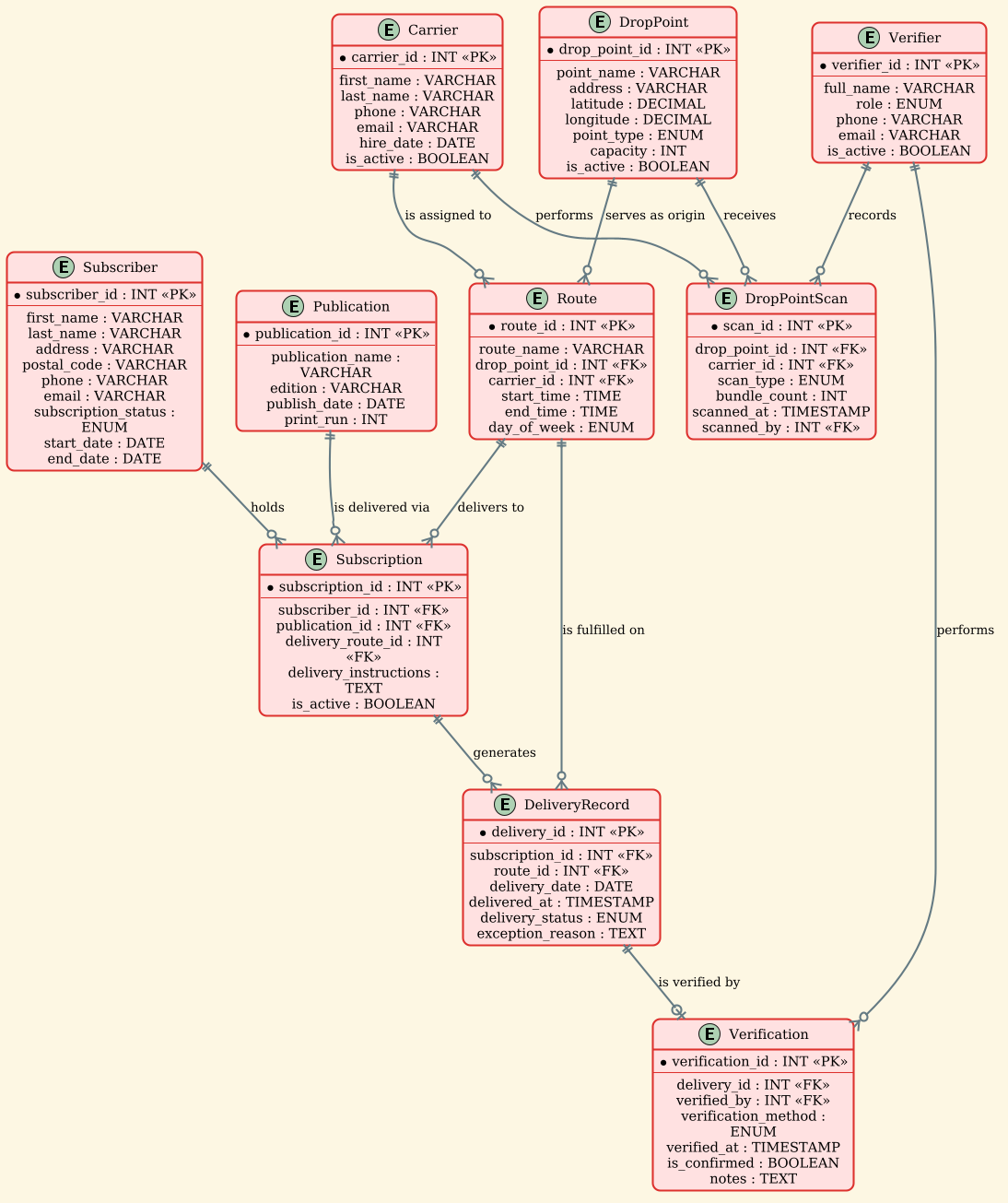
The scope of this diagram focuses on three critical pillars of the circulation business: Infrastructure Management (Drop Points), Workforce & Routing (Carriers and Routes), and Verification & Compliance (Delivery Records and Subscribers). By isolating these domains, we can model the cardinality of relationships accurately. For instance, a single carrier can serve multiple routes, but a specific route on a specific day is anchored to a single drop point. Similarly, the verification process is distinct from the delivery itself; a delivery record might exist without a verification, but a verification record cannot exist without a corresponding delivery.
By the end of this tutorial, you will gain insights into how to model complex many-to-many relationships through intermediate entities (like Subscription), how to handle temporal data (delivery timestamps, hire dates), and how to structure exception handling (delivery status and verification notes) directly into the schema. This model empowers circulation managers to query data efficiently, such as identifying carriers with high exception rates or analyzing drop point capacity utilization.
Complete Diagram & Full Source Code
Below is the complete blueprint for the Newspaper Circulation ERD. This diagram utilizes the sunlust theme to provide a warm, professional aesthetic suitable for logistics documentation. It defines ten distinct entities, ranging from the physical drop points to the digital verification records, connected by precise relationships that reflect real-world logistics constraints.
@startuml
/'
Diagram Context:
This ERD models the backend data structure for a newspaper print edition circulation
management system. It addresses two core operational challenges: managing the network
of drop points where bundled newspapers are deposited for carriers, and verifying that
subscribers actually receive their delivered copies. The diagram captures drop point
locations, carrier assignments, subscriber delivery routes, and the verification
records that confirm successful delivery or flag exceptions. This supports circulation
managers in tracking distribution efficiency and resolving delivery disputes.
'/
!theme sunlust

entity "DropPoint" as droppoint {
  *drop_point_id : INT <<PK>>
  --
  point_name : VARCHAR
  address : VARCHAR
  latitude : DECIMAL
  longitude : DECIMAL
  point_type : ENUM
  capacity : INT
  is_active : BOOLEAN
}

entity "Carrier" as carrier {
  *carrier_id : INT <<PK>>
  --
  first_name : VARCHAR
  last_name : VARCHAR
  phone : VARCHAR
  email : VARCHAR
  hire_date : DATE
  is_active : BOOLEAN
}

entity "Route" as route {
  *route_id : INT <<PK>>
  --
  route_name : VARCHAR
  drop_point_id : INT <<FK>>
  carrier_id : INT <<FK>>
  start_time : TIME
  end_time : TIME
  day_of_week : ENUM
}

entity "Subscriber" as subscriber {
  *subscriber_id : INT <<PK>>
  --
  first_name : VARCHAR
  last_name : VARCHAR
  address : VARCHAR
  postal_code : VARCHAR
  phone : VARCHAR
  email : VARCHAR
  subscription_status : ENUM
  start_date : DATE
  end_date : DATE
}

entity "Subscription" as subscription {
  *subscription_id : INT <<PK>>
  --
  subscriber_id : INT <<FK>>
  publication_id : INT <<FK>>
  delivery_route_id : INT <<FK>>
  delivery_instructions : TEXT
  is_active : BOOLEAN
}

entity "Publication" as publication {
  *publication_id : INT <<PK>>
  --
  publication_name : VARCHAR
  edition : VARCHAR
  publish_date : DATE
  print_run : INT
}

entity "DeliveryRecord" as delivery {
  *delivery_id : INT <<PK>>
  --
  subscription_id : INT <<FK>>
  route_id : INT <<FK>>
  delivery_date : DATE
  delivered_at : TIMESTAMP
  delivery_status : ENUM
  exception_reason : TEXT
}

entity "Verification" as verification {
  *verification_id : INT <<PK>>
  --
  delivery_id : INT <<FK>>
  verified_by : INT <<FK>>
  verification_method : ENUM
  verified_at : TIMESTAMP
  is_confirmed : BOOLEAN
  notes : TEXT
}

entity "Verifier" as verifier {
  *verifier_id : INT <<PK>>
  --
  full_name : VARCHAR
  role : ENUM
  phone : VARCHAR
  email : VARCHAR
  is_active : BOOLEAN
}

entity "DropPointScan" as scan {
  *scan_id : INT <<PK>>
  --
  drop_point_id : INT <<FK>>
  carrier_id : INT <<FK>>
  scan_type : ENUM
  bundle_count : INT
  scanned_at : TIMESTAMP
  scanned_by : INT <<FK>>
}

carrier ||--o{ route : "is assigned to"
droppoint ||--o{ route : "serves as origin"
route ||--o{ subscription : "delivers to"
subscriber ||--o{ subscription : "holds"
publication ||--o{ subscription : "is delivered via"
subscription ||--o{ delivery : "generates"
route ||--o{ delivery : "is fulfilled on"
delivery ||--o| verification : "is verified by"
verifier ||--o{ verification : "performs"
droppoint ||--o{ scan : "receives"
carrier ||--o{ scan : "performs"
verifier ||--o{ scan : "records"

@endumlStep-by-Step Architectural Walkthrough
Phase 1: Canvas Configuration & Layout Directives
Every PlantUML diagram begins with setup directives that define the visual identity and layout engine. In this model, we prioritize a clean, professional look that aids readability for stakeholders. We start by declaring the diagram type and adding a contextual comment block to explain the business scope.
First, we define the comment block using the /' ... '/ syntax. This allows us to embed a high-level summary directly in the source code, ensuring that the diagram’s purpose is documented alongside the technical schema. This is a best practice for maintaining living documentation.
/'
Diagram Context:
This ERD models the backend data structure for a newspaper print edition circulation
management system...
'/
Next, we apply the !theme sunlust directive. This loads a specific color palette and styling set from the PlantUML standard library, giving the diagram a warm, cohesive appearance without requiring manual styling of every element. This keeps the code clean and the visual output consistent.
Phase 2: Declaring Core Entities, Actors, and Boundaries
The backbone of an ERD is the entity definition. We break down the system into logical groups. The first group represents the physical infrastructure: the DropPoint. This entity captures not just the address, but geospatial data (latitude, longitude) and capacity limits, which are critical for logistics optimization.
We then define the human actors: Carrier and Verifier. Note the use of * for the Primary Key (PK) and INT for the data type. The Carrier entity includes contact information and status flags (is_active), which are essential for dispatch systems. Similarly, the Verifier entity models the personnel responsible for auditing deliveries.
entity "DropPoint" as droppoint {
  *drop_point_id : INT <>
  --
  point_name : VARCHAR
  address : VARCHAR
  latitude : DECIMAL
  longitude : DECIMAL
  ...
The Subscriber and Publication entities define the product and the customer. The Subscription entity acts as the crucial bridge, linking a subscriber to a specific publication and a delivery route. This many-to-many relationship (one subscriber can have multiple subscriptions, one subscription belongs to one subscriber) is elegantly handled by the Subscription entity acting as an associative table.
Phase 3: Mapping Data Flows & Key Interactions
The final phase involves defining the relationships that drive the business logic. In PlantUML, we use the ||--o{ and ||--o| syntax to denote cardinality and optionality. The || represents mandatory participation (one-to-one), while o{ represents optional participation (one-to-many).
For example, the relationship between Carrier and Route is defined as carrier ||--o{ route : "is assigned to". This means a Carrier must exist (mandatory), but a specific carrier might not be assigned to a route on a given day (optional/zero). Conversely, a Route must be assigned to exactly one DropPoint (the origin) and one Carrier.
We also model the verification flow. The DeliveryRecord is linked to Verification with delivery ||--o| verification. The | indicates that a delivery might not always have a verification record (e.g., if the system is offline or the verification is pending), but a verification record must correspond to exactly one delivery.
carrier ||--o{ route : "is assigned to"
droppoint ||--o{ route : "serves as origin"
route ||--o{ subscription : "delivers to"
subscriber ||--o{ subscription : "holds"
...
delivery ||--o| verification : "is verified by"
Phase 4: Grouping, Annotations & Visual Polish
To enhance readability, we utilize the as alias feature to give entities shorter, internal names (e.g., entity "DropPoint" as droppoint). This prevents the diagram from becoming cluttered with long entity names, allowing the relationship lines to be drawn cleanly. We also use the -- separator within entities to visually group attributes, separating keys from descriptive fields.
The DropPointScan entity is a specialized entity designed to track the physical handover of bundles at the start of a route. It links the DropPoint, the Carrier, and the Verifier (who might record the scan), creating a complete audit trail for the start of the shift.
Syntax & Keyword Deep Dive
To build this ERD effectively, understanding the specific PlantUML keywords is essential. Here is a breakdown of the critical syntax elements used in this model:
entity: The fundamental building block for defining a table or class. The syntaxentity "Display Name" as internal_nameallows for a readable label while maintaining a clean internal reference.<&> <: Stereotypes used to denote Primary Keys and Foreign Keys. These are crucial for database designers to understand the referential integrity of the schema.> ||--o{: A relationship connector representing a “One-to-Many” optional relationship. The||indicates the “One” side is mandatory, and theo{indicates the “Many” side is optional (zero or more).||--o|: A relationship connector representing a “One-to-One or One-to-Many” relationship where the “One” side is mandatory, and the “Many” side is optional, but if it exists, it is strictly one (often used for unique constraints or specific verification states).!theme: A directive to load a pre-defined visual theme.sunlust/' ... '/: The syntax for a multi-line comment block. This is used here to embed the diagram context description directly into the code file.
Best Practices & Pitfalls to Avoid
When modeling complex logistics systems like newspaper circulation, adhering to best practices ensures your diagram remains maintainable and accurate.
- Normalize Your Data: Notice how we separated
Subscriber,Publication, andSubscription. A common pitfall is combining these into a single table, which leads to data redundancy. Always use an associative entity (likeSubscription) to handle many-to-many relationships. - Use Consistent Naming Conventions: We used camelCase for internal aliases (e.g.,
droppoint) and TitleCase for display names. Stick to one convention to avoid confusion when referencing entities in your code. - Document Cardinality Clearly: Don’t just draw lines; label them. The relationship labels (e.g., “is assigned to”) provide immediate context that a visual line alone cannot convey.
- Separate Operational Data from Master Data: Entities like
DropPointScanrepresent operational transactions (events), whileCarrierrepresents master data (static records). Keeping these distinct helps in querying for historical trends vs. current state.
Start Building Logistics ERDs Faster with VPasCode
Instantly prototype, test, and export your Newspaper Circulation database schema online with VPasCode’s free PlantUML editor—no installation required.