


In the complex landscape of financial services, clarity is currency. When managing debt collection workflows, ambiguity in system design can lead to compliance risks, operational bottlenecks, and data integrity issues. A well-structured Class Diagram serves as the blueprint for the underlying software architecture, defining entities like DebtAccount, Debtor, and CollectionAgent, and how they interact.

This tutorial leverages VPasCode, a free web-based diagram-as-code tool, to build a comprehensive PlantUML Class Diagram for a Debt Collection System. By using diagram-as-code, architects can manage their logic textually, collaborate via code reviews, and instantly visualize complex financial relationships without the overhead of manual drag-and-drop tools.
VPasCode eliminates the need for local Java or Graphviz installations, allowing you to render high-fidelity diagrams directly in the browser. This accessibility is crucial for finance teams who need to prototype and validate system models quickly without IT bottlenecks.
Understanding the Model: Purpose, Scope & Problem Framing
Diagram Abstraction & Representation
A Class Diagram models the static structure of a system. In this context, it defines the attributes and methods available to each component. For a Debt Collection System, this is critical for ensuring that financial calculations (like interest or EMI) are encapsulated correctly within their respective classes. It visualizes the data model that developers will translate into database schemas and backend code.
Target Domain Scope & Scenario
The diagram covers the core lifecycle of a debt: from creation (via DebtAccount) to payment processing (Payment), and potential escalation to legal action (LegalAction). It excludes external marketing channels to focus on the backend data model and operational logic. The scope includes:
- Debt Management: Handling various debt types (Credit Card, Loan, Medical).
- Debtor Management: Tracking customer profiles and contact information.
- Collection Operations: Assigning agents and strategies.
- Financial Transactions: Recording payments and settlements.
Key Takeaways & Educational Insights
Readers will learn how to model inheritance hierarchies (e.g., CreditCardDebt extending DebtAccount), manage cardinalities (e.g., one Debtor owns many Accounts), and distinguish between composition and aggregation. This knowledge is essential for building scalable, compliant financial software.
Complete Diagram & Full Source Code
Below is the complete blueprint. You can copy this code directly into the VPasCode editor to render the diagram instantly.
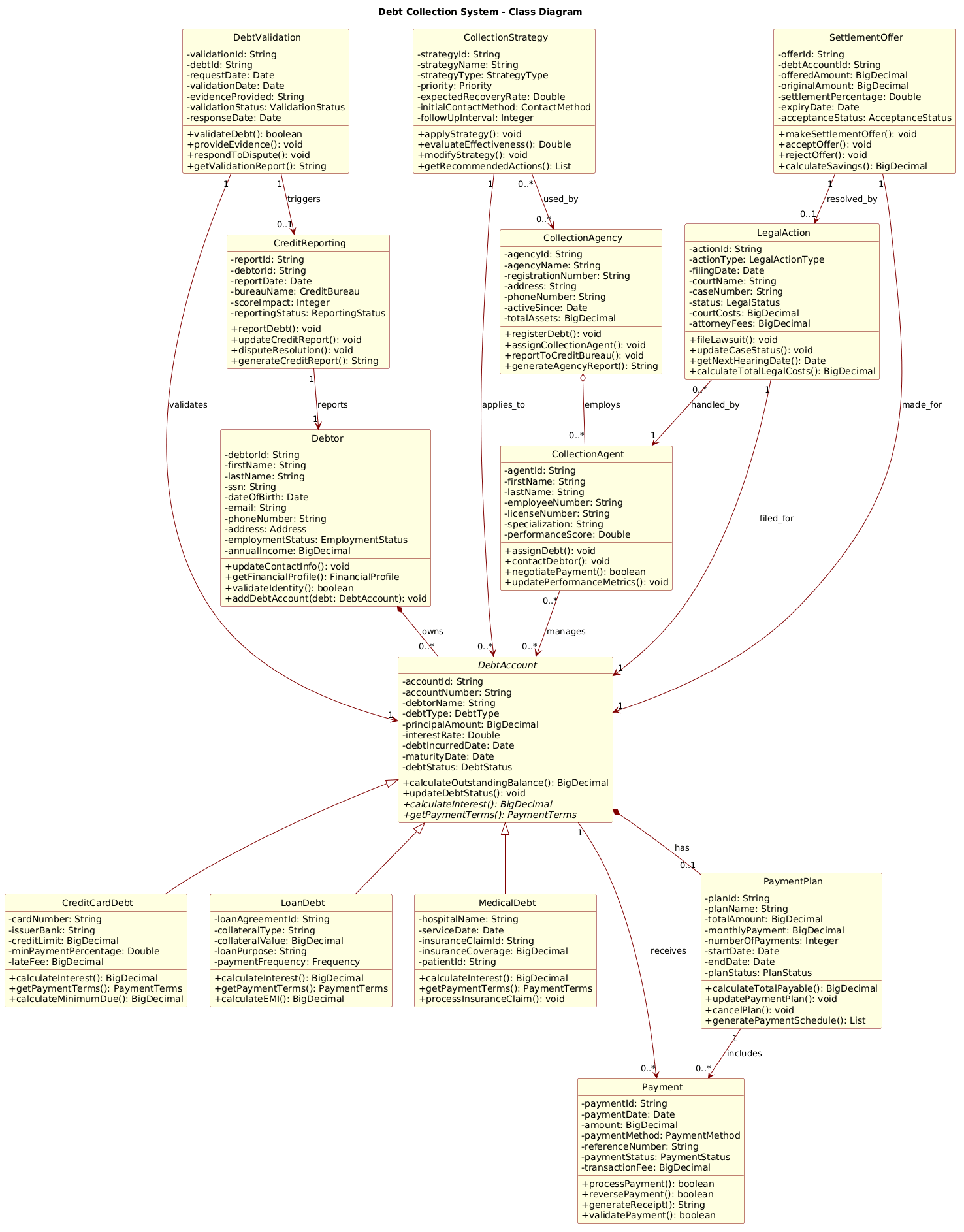
@startuml

!include https://static.visual-paradigm.com/web/resources/plantuml-stdlib/themes/rose.puml

title Debt Collection System - Class Diagram

' Abstract base class
abstract class DebtAccount {
  - accountId: String
  - accountNumber: String
  - debtorName: String
  - debtType: DebtType
  - principalAmount: BigDecimal
  - interestRate: Double
  - debtIncurredDate: Date
  - maturityDate: Date
  - debtStatus: DebtStatus
  + calculateOutstandingBalance(): BigDecimal
  + updateDebtStatus(): void
  + {abstract} calculateInterest(): BigDecimal
  + {abstract} getPaymentTerms(): PaymentTerms
}

' Derived classes from DebtAccount
class CreditCardDebt {
  - cardNumber: String
  - issuerBank: String
  - creditLimit: BigDecimal
  - minPaymentPercentage: Double
  - lateFee: BigDecimal
  + calculateInterest(): BigDecimal
  + getPaymentTerms(): PaymentTerms
  + calculateMinimumDue(): BigDecimal
}

class LoanDebt {
  - loanAgreementId: String
  - collateralType: String
  - collateralValue: BigDecimal
  - loanPurpose: String
  - paymentFrequency: Frequency
  + calculateInterest(): BigDecimal
  + getPaymentTerms(): PaymentTerms
  + calculateEMI(): BigDecimal
}

class MedicalDebt {
  - hospitalName: String
  - serviceDate: Date
  - insuranceClaimId: String
  - insuranceCoverage: BigDecimal
  - patientId: String
  + calculateInterest(): BigDecimal
  + getPaymentTerms(): PaymentTerms
  + processInsuranceClaim(): void
}

' Debtor class
class Debtor {
  - debtorId: String
  - firstName: String
  - lastName: String
  - ssn: String
  - dateOfBirth: Date
  - email: String
  - phoneNumber: String
  - address: Address
  - employmentStatus: EmploymentStatus
  - annualIncome: BigDecimal
  + updateContactInfo(): void
  + getFinancialProfile(): FinancialProfile
  + validateIdentity(): boolean
  + addDebtAccount(debt: DebtAccount): void
}

' PaymentPlan class
class PaymentPlan {
  - planId: String
  - planName: String
  - totalAmount: BigDecimal
  - monthlyPayment: BigDecimal
  - numberOfPayments: Integer
  - startDate: Date
  - endDate: Date
  - planStatus: PlanStatus
  + calculateTotalPayable(): BigDecimal
  + updatePaymentPlan(): void
  + cancelPlan(): void
  + generatePaymentSchedule(): List
}

' Payment class
class Payment {
  - paymentId: String
  - paymentDate: Date
  - amount: BigDecimal
  - paymentMethod: PaymentMethod
  - referenceNumber: String
  - paymentStatus: PaymentStatus
  - transactionFee: BigDecimal
  + processPayment(): boolean
  + reversePayment(): boolean
  + generateReceipt(): String
  + validatePayment(): boolean
}

' CollectionAgent class
class CollectionAgent {
  - agentId: String
  - firstName: String
  - lastName: String
  - employeeNumber: String
  - licenseNumber: String
  - specialization: String
  - performanceScore: Double
  + assignDebt(): void
  + contactDebtor(): void
  + negotiatePayment(): boolean
  + updatePerformanceMetrics(): void
}

' CollectionStrategy class
class CollectionStrategy {
  - strategyId: String
  - strategyName: String
  - strategyType: StrategyType
  - priority: Priority
  - expectedRecoveryRate: Double
  - initialContactMethod: ContactMethod
  - followUpInterval: Integer
  + applyStrategy(): void
  + evaluateEffectiveness(): Double
  + modifyStrategy(): void
  + getRecommendedActions(): List
}

' CollectionAgency class
class CollectionAgency {
  - agencyId: String
  - agencyName: String
  - registrationNumber: String
  - address: String
  - phoneNumber: String
  - activeSince: Date
  - totalAssets: BigDecimal
  + registerDebt(): void
  + assignCollectionAgent(): void
  + reportToCreditBureau(): void
  + generateAgencyReport(): String
}

' LegalAction class
class LegalAction {
  - actionId: String
  - actionType: LegalActionType
  - filingDate: Date
  - courtName: String
  - caseNumber: String
  - status: LegalStatus
  - courtCosts: BigDecimal
  - attorneyFees: BigDecimal
  + fileLawsuit(): void
  + updateCaseStatus(): void
  + getNextHearingDate(): Date
  + calculateTotalLegalCosts(): BigDecimal
}

' DebtValidation class
class DebtValidation {
  - validationId: String
  - debtId: String
  - requestDate: Date
  - validationDate: Date
  - evidenceProvided: String
  - validationStatus: ValidationStatus
  - responseDate: Date
  + validateDebt(): boolean
  + provideEvidence(): void
  + respondToDispute(): void
  + getValidationReport(): String
}

' CreditReporting class
class CreditReporting {
  - reportId: String
  - debtorId: String
  - reportDate: Date
  - bureauName: CreditBureau
  - scoreImpact: Integer
  - reportingStatus: ReportingStatus
  + reportDebt(): void
  + updateCreditReport(): void
  + disputeResolution(): void
  + generateCreditReport(): String
}

' SettlementOffer class
class SettlementOffer {
  - offerId: String
  - debtAccountId: String
  - offeredAmount: BigDecimal
  - originalAmount: BigDecimal
  - settlementPercentage: Double
  - expiryDate: Date
  - acceptanceStatus: AcceptanceStatus
  + makeSettlementOffer(): void
  + acceptOffer(): void
  + rejectOffer(): void
  + calculateSavings(): BigDecimal
}

' ============ Relationships ============

' Generalization (Inheritance)
DebtAccount <|-- CreditCardDebt
DebtAccount <|-- LoanDebt
DebtAccount <|-- MedicalDebt

' Composition (Debtor - DebtAccount) - Strong ownership
Debtor *-- "0..*" DebtAccount : owns

' Composition (DebtAccount - PaymentPlan) - Strong ownership
DebtAccount *-- "0..1" PaymentPlan : has

' Association (DebtAccount - Payment) - One-to-Many
DebtAccount "1" --> "0..*" Payment : receives

' Association (CollectionAgent - DebtAccount) - Many-to-Many
CollectionAgent "0..*" --> "0..*" DebtAccount : manages

' Aggregation (CollectionAgency - CollectionAgent) - Weak ownership
CollectionAgency o-- "0..*" CollectionAgent : employs

' Association (CollectionStrategy - DebtAccount) - One-to-Many
CollectionStrategy "1" --> "0..*" DebtAccount : applies_to

' Association (LegalAction - DebtAccount) - One-to-One
LegalAction "1" --> "1" DebtAccount : filed_for

' Association (DebtValidation - DebtAccount) - One-to-One
DebtValidation "1" --> "1" DebtAccount : validates

' Association (CreditReporting - Debtor) - One-to-One
CreditReporting "1" --> "1" Debtor : reports

' Association (SettlementOffer - DebtAccount) - One-to-One
SettlementOffer "1" --> "1" DebtAccount : made_for

' Association (CollectionStrategy - CollectionAgency) - Many-to-Many
CollectionStrategy "0..*" --> "0..*" CollectionAgency : used_by

' Association (PaymentPlan - Payment) - One-to-Many
PaymentPlan "1" --> "0..*" Payment : includes

' Association (LegalAction - CollectionAgent) - One-to-Many
LegalAction "0..*" --> "1" CollectionAgent : handled_by

' Association (SettlementOffer - LegalAction) - One-to-One
SettlementOffer "1" --> "0..1" LegalAction : resolved_by

' Association (DebtValidation - CreditReporting) - One-to-One
DebtValidation "1" --> "0..1" CreditReporting : triggers

@endumlStep-by-Step Architectural Walkthrough
Building a professional diagram requires a structured approach. We will break down the creation process into four distinct phases to ensure logical consistency and visual clarity.
Phase 1: Canvas Configuration & Layout Directives
Before defining classes, we set the visual theme. This ensures the diagram adheres to a consistent style guide. We use the rose.puml theme from the PlantUML standard library to give the diagram a polished, professional appearance suitable for financial presentations.
!include https://static.visual-paradigm.com/web/resources/plantuml-stdlib/themes/rose.pumlThis directive must appear at the very top of the code. It loads the necessary skin parameters and styles without requiring local file management.
Phase 2: Declaring Core Entities, Actors, and Boundaries
The foundation of the system is the DebtAccount class. We define it as an abstract class to enforce polymorphism. This means DebtAccount cannot be instantiated directly but serves as a blueprint for specific debt types.
abstract class DebtAccount {
  - accountId: String
  ...
We then define derived classes like CreditCardDebt, LoanDebt, and MedicalDebt. Each inherits the core attributes from DebtAccount but adds specific fields relevant to their domain (e.g., cardNumber for credit cards, collateralValue for loans).
Phase 3: Mapping Data Flows & Key Interactions
Relationships define how data flows between entities. We use composition (*--) to indicate strong ownership. For instance, a Debtor owns DebtAccount instances. If the Debtor is deleted, their accounts logically cease to exist in this context.
Debtor *-- "0..*" DebtAccount : ownsWe also model associations (-->) for weaker links, such as a CollectionAgent managing a debt account. This allows flexibility where an agent can manage multiple debts, and a debt can be managed by different agents over time.
Phase 4: Grouping, Annotations & Visual Polish
The final phase involves ensuring all necessary business logic methods are visible. We include methods like calculateInterest() and updateDebtStatus() to make the diagram actionable for developers. We also add cardinality labels (e.g., "0..*") to clarify the number of instances allowed in a relationship, preventing ambiguity during implementation.
Syntax & Keyword Deep Dive
Understanding the specific PlantUML syntax is crucial for maintaining and extending your diagrams. Here are the key features used in this Debt Collection System model.
abstract class: Defines a blueprint that cannot be instantiated directly. It ensures that specific implementations (likeCreditCardDebt) must adhere to the base structure.*--(Composition): Indicates a strong ownership relationship where the child cannot exist without the parent. Used here forDebtorowningDebtAccount.o--(Aggregation): Indicates a weak ownership relationship. Used forCollectionAgencyemployingCollectionAgent, where an agent can exist independently of the agency.-->(Association): A general link between two classes without implying ownership. Used forPaymentbeing received byDebtAccount.<|--(Inheritance): Shows a generalization relationship where a subclass extends a superclass. Used for debt types extendingDebtAccount.{abstract