


In the finance and banking industry, audit logging systems serve as the backbone of compliance, security monitoring, and regulatory adherence. Financial institutions must maintain detailed records of every user action, data modification, and system access to meet requirements from frameworks like SOX, GDPR, and PCI-DSS. A well-designed class diagram for an Audit Logging System provides architects and developers with a clear blueprint of how audit events are captured, stored, analyzed, and reported.

Diagramming-as-code with PlantUML in VPasCode transforms this architectural challenge into an efficient workflow. Instead of manually drawing boxes and arrows in traditional diagramming tools, developers can write concise, version-ready code that automatically renders professional class diagrams. This approach enhances architectural clarity, enables rapid visual prototyping, and creates living technical documentation that evolves with your system.
Understanding the Model: Purpose, Scope & Problem Framing
Diagram Abstraction & Representation
A class diagram in PlantUML models the static structure of a system by defining classes, their attributes, methods, and the relationships between them. For an Audit Logging System, this abstraction is critical because it reveals:
- Entity Boundaries: How audit events, configurations, and reports are organized as distinct objects.
- Inheritance Hierarchies: How different audit event types (access, data, security) share common behaviors through polymorphism.
- Ownership & Composition: Which components strongly own audit data versus which maintain weak associations.
- Cardinality Constraints: How many events relate to a single log, session, or report.
Target Domain Scope & Scenario
This tutorial focuses on a comprehensive Audit Logging System designed for financial compliance scenarios. The diagram covers:
- Audit Event Capture: Recording access attempts, data changes, and security incidents.
- Log Management: Storing, filtering, archiving, and purging audit logs.
- Analytics & Reporting: Generating compliance reports and detecting anomalies.
- Alerting Mechanisms: Configuring rules and sending notifications for critical events.
- Integrity Verification: Ensuring logs cannot be tampered with through hash validation.
Key Takeaways & Educational Insights
By studying this model, readers will gain:
- Understanding of how to model inheritance hierarchies for extensible audit event types.
- Clear patterns for composition vs. aggregation relationships in system design.
- Best practices for organizing financial compliance-related class structures.
- Practical PlantUML syntax for defining attributes, methods, and cardinalities.
Complete Diagram & Full Source Code
Below is the finished Audit Logging System class diagram. This comprehensive model includes 15+ classes with inheritance, composition, aggregation, and association relationships that demonstrate real-world financial system architecture patterns.
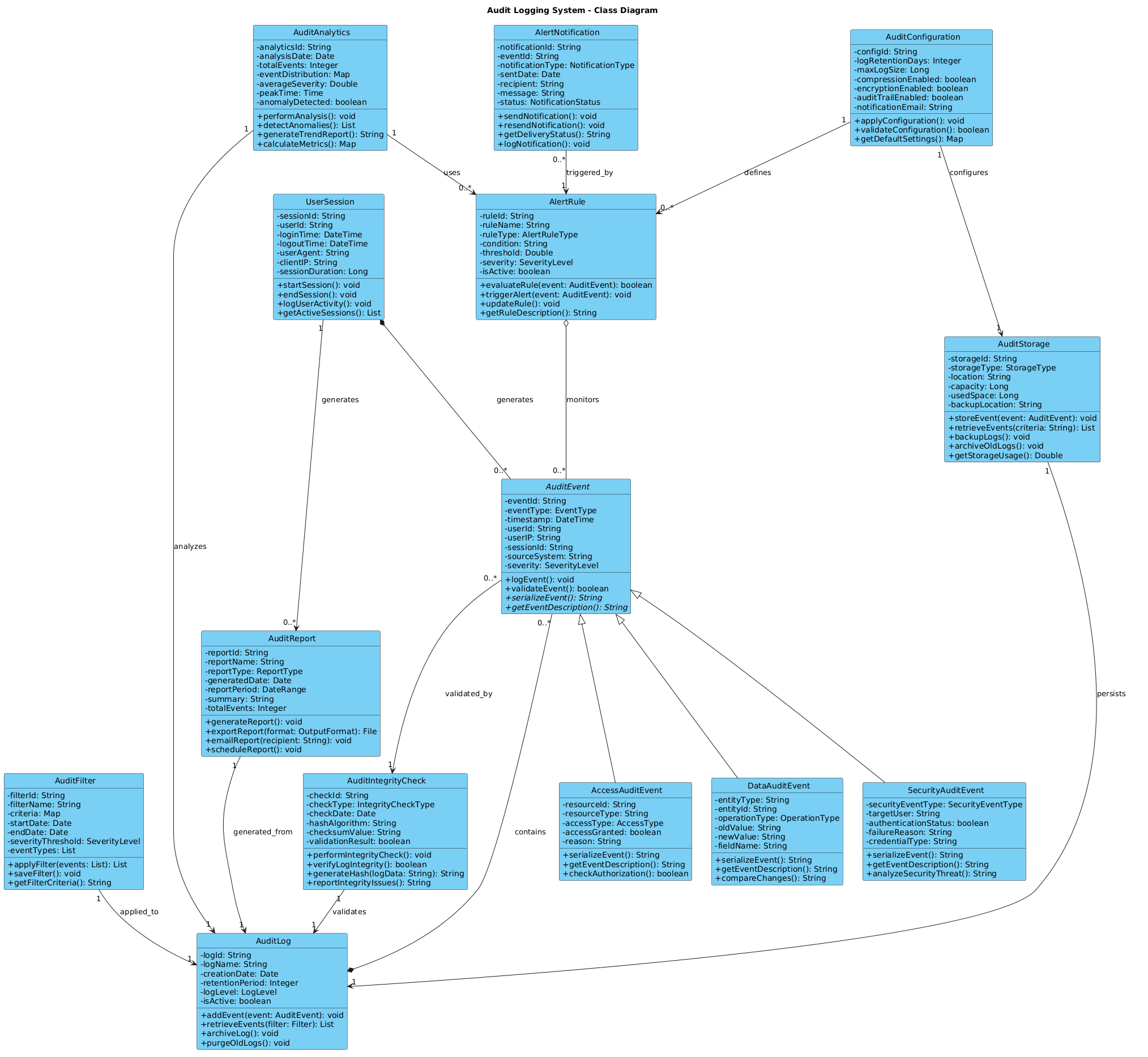
@startuml

!include https://static.visual-paradigm.com/web/resources/plantuml-stdlib/themes/vp.puml

title Audit Logging System - Class Diagram

' Abstract base class
abstract class AuditEvent {
  - eventId: String
  - eventType: EventType
  - timestamp: DateTime
  - userId: String
  - userIP: String
  - sessionId: String
  - sourceSystem: String
  - severity: SeverityLevel
  + logEvent(): void
  + validateEvent(): boolean
  + {abstract} serializeEvent(): String
  + {abstract} getEventDescription(): String
}

' Derived classes from AuditEvent
class AccessAuditEvent {
  - resourceId: String
  - resourceType: String
  - accessType: AccessType
  - accessGranted: boolean
  - reason: String
  + serializeEvent(): String
  + getEventDescription(): String
  + checkAuthorization(): boolean
}

class DataAuditEvent {
  - entityType: String
  - entityId: String
  - operationType: OperationType
  - oldValue: String
  - newValue: String
  - fieldName: String
  + serializeEvent(): String
  + getEventDescription(): String
  + compareChanges(): String
}

class SecurityAuditEvent {
  - securityEventType: SecurityEventType
  - targetUser: String
  - authenticationStatus: boolean
  - failureReason: String
  - credentialType: String
  + serializeEvent(): String
  + getEventDescription(): String
  + analyzeSecurityThreat(): String
}

' AuditLog class
class AuditLog {
  - logId: String
  - logName: String
  - creationDate: Date
  - retentionPeriod: Integer
  - logLevel: LogLevel
  - isActive: boolean
  + addEvent(event: AuditEvent): void
  + retrieveEvents(filter: Filter): List
  + archiveLog(): void
  + purgeOldLogs(): void
}

' AuditConfiguration class
class AuditConfiguration {
  - configId: String
  - logRetentionDays: Integer
  - maxLogSize: Long
  - compressionEnabled: boolean
  - encryptionEnabled: boolean
  - auditTrailEnabled: boolean
  - notificationEmail: String
  + applyConfiguration(): void
  + validateConfiguration(): boolean
  + getDefaultSettings(): Map
}

' AuditFilter class
class AuditFilter {
  - filterId: String
  - filterName: String
  - criteria: Map
  - startDate: Date
  - endDate: Date
  - severityThreshold: SeverityLevel
  - eventTypes: List
  + applyFilter(events: List): List
  + saveFilter(): void
  + getFilterCriteria(): String
}

' AuditReport class
class AuditReport {
  - reportId: String
  - reportName: String
  - reportType: ReportType
  - generatedDate: Date
  - reportPeriod: DateRange
  - summary: String
  - totalEvents: Integer
  + generateReport(): void
  + exportReport(format: OutputFormat): File
  + emailReport(recipient: String): void
  + scheduleReport(): void
}

' AuditAnalytics class
class AuditAnalytics {
  - analyticsId: String
  - analysisDate: Date
  - totalEvents: Integer
  - eventDistribution: Map
  - averageSeverity: Double
  - peakTime: Time
  - anomalyDetected: boolean
  + performAnalysis(): void
  + detectAnomalies(): List
  + generateTrendReport(): String
  + calculateMetrics(): Map
}

' AlertRule class
class AlertRule {
  - ruleId: String
  - ruleName: String
  - ruleType: AlertRuleType
  - condition: String
  - threshold: Double
  - severity: SeverityLevel
  - isActive: boolean
  + evaluateRule(event: AuditEvent): boolean
  + triggerAlert(event: AuditEvent): void
  + updateRule(): void
  + getRuleDescription(): String
}

' AlertNotification class
class AlertNotification {
  - notificationId: String
  - eventId: String
  - notificationType: NotificationType
  - sentDate: Date
  - recipient: String
  - message: String
  - status: NotificationStatus
  + sendNotification(): void
  + resendNotification(): void
  + getDeliveryStatus(): String
  + logNotification(): void
}

' AuditStorage class
class AuditStorage {
  - storageId: String
  - storageType: StorageType
  - location: String
  - capacity: Long
  - usedSpace: Long
  - backupLocation: String
  + storeEvent(event: AuditEvent): void
  + retrieveEvents(criteria: String): List
  + backupLogs(): void
  + archiveOldLogs(): void
  + getStorageUsage(): Double
}

' UserSession class
class UserSession {
  - sessionId: String
  - userId: String
  - loginTime: DateTime
  - logoutTime: DateTime
  - userAgent: String
  - clientIP: String
  - sessionDuration: Long
  + startSession(): void
  + endSession(): void
  + logUserActivity(): void
  + getActiveSessions(): List
}

' AuditIntegrityCheck class
class AuditIntegrityCheck {
  - checkId: String
  - checkType: IntegrityCheckType
  - checkDate: Date
  - hashAlgorithm: String
  - checksumValue: String
  - validationResult: boolean
  + performIntegrityCheck(): void
  + verifyLogIntegrity(): boolean
  + generateHash(logData: String): String
  + reportIntegrityIssues(): String
}

' ============ Relationships ============

' Generalization (Inheritance)
AuditEvent <|-- AccessAuditEvent
AuditEvent <|-- DataAuditEvent
AuditEvent <|-- SecurityAuditEvent

' Composition (AuditLog - AuditEvent) - Strong ownership
AuditLog *-- "0..*" AuditEvent : contains

' Composition (UserSession - AuditEvent) - Strong ownership
UserSession *-- "0..*" AuditEvent : generates

' Association (AuditFilter - AuditLog) - One-to-One
AuditFilter "1" --> "1" AuditLog : applied_to

' Association (AuditReport - AuditLog) - One-to-One
AuditReport "1" --> "1" AuditLog : generated_from

' Association (AuditAnalytics - AuditLog) - One-to-One
AuditAnalytics "1" --> "1" AuditLog : analyzes

' Aggregation (AlertRule - AuditEvent) - Weak ownership
AlertRule o-- "0..*" AuditEvent : monitors

' Association (AlertNotification - AlertRule) - One-to-Many
AlertNotification "0..*" --> "1" AlertRule : triggered_by

' Association (AuditStorage - AuditLog) - One-to-One
AuditStorage "1" --> "1" AuditLog : persists

' Association (AuditConfiguration - AuditStorage) - One-to-One
AuditConfiguration "1" --> "1" AuditStorage : configures

' Association (AuditIntegrityCheck - AuditLog) - One-to-One
AuditIntegrityCheck "1" --> "1" AuditLog : validates

' Association (UserSession - AuditReport) - One-to-Many
UserSession "1" --> "0..*" AuditReport : generates

' Association (AuditAnalytics - AlertRule) - One-to-Many
AuditAnalytics "1" --> "0..*" AlertRule : uses

' Association (AuditConfiguration - AlertRule) - One-to-Many
AuditConfiguration "1" --> "0..*" AlertRule : defines

' Association (AuditEvent - AuditIntegrityCheck) - Many-to-One
AuditEvent "0..*" --> "1" AuditIntegrityCheck : validated_by

@endumlStep-by-Step Architectural Walkthrough
Phase 1: Canvas Configuration & Layout Directives
Every PlantUML diagram begins with setup directives that define the rendering environment. In this Audit Logging System diagram, we use:
@startuml
!include https://static.visual-paradigm.com/web/resources/plantuml-stdlib/themes/vp.puml
title Audit Logging System - Class Diagram
The @startuml directive marks the beginning of the diagram. The !include directive pulls in the VP theme stylesheet, which provides consistent styling for all classes. The title directive adds a descriptive header that appears above the rendered diagram.
Phase 2: Declaring Core Entities, Actors, and Boundaries
We start by defining the abstract base class AuditEvent, which serves as the foundation for all audit event types. This class contains common attributes like eventId, timestamp, userId, and severity, along with methods for logging and validation.
abstract class AuditEvent {
  - eventId: String
  - eventType: EventType
  - timestamp: DateTime
  - userId: String
  - userIP: String
  - sessionId: String
  - sourceSystem: String
  - severity: SeverityLevel
  + logEvent(): void
  + validateEvent(): boolean
  + {abstract} serializeEvent(): String
  + {abstract} getEventDescription(): String
}
The abstract keyword indicates this class cannot be instantiated directly. The {abstract} modifier on methods signals that derived classes must implement these behaviors. Private attributes use -, while public methods use +.
Phase 3: Mapping Data Flows & Key Interactions
Next, we define concrete audit event types that inherit from AuditEvent. Each specialized class adds domain-specific attributes and methods:
class AccessAuditEvent {
  - resourceId: String
  - resourceType: String
  - accessType: AccessType
  - accessGranted: boolean
  - reason: String
  + serializeEvent(): String
  + getEventDescription(): String
  + checkAuthorization(): boolean
}
The inheritance relationship is declared using the <|-- arrow notation, which indicates that AccessAuditEvent extends AuditEvent. This pattern is repeated for DataAuditEvent and SecurityAuditEvent, creating a polymorphic hierarchy for event handling.
Phase 4: Grouping, Annotations & Visual Polish
Finally, we define the relationships between all classes. These relationships communicate ownership, cardinality, and interaction patterns:
AuditLog *-- "0..*" AuditEvent : contains
AuditFilter "1" --> "1" AuditLog : applied_to
AlertRule o-- "0..*" AuditEvent : monitors
The * symbol indicates composition (strong ownership), while o indicates aggregation (weak ownership). Cardinality constraints like "0..*" specify minimum and maximum relationship counts. Labels like contains and applied_to clarify the semantic meaning of each relationship.
Syntax & Keyword Deep Dive
PlantUML provides a rich set of keywords for class diagram modeling. Here are the essential features used in this Audit Logging System diagram:
abstract class: Declares a class that cannot be instantiated directly and serves as a base for inheritance.class: Defines a concrete class with attributes and methods that can be instantiated.-(hyphen): Marks attributes or methods as private (accessible only within the class).+(plus): Marks attributes or methods as public (accessible from outside the class).{abstract}: Specifies that a method must be implemented by derived classes.<|--: Indicates generalization (inheritance) from parent to child class.*--: Indicates composition (strong ownership relationship).o--: Indicates aggregation (weak ownership relationship)."1" --> "1": Specifies one-to-one association cardinality between classes."0..*": Specifies zero or more (many) relationship cardinality.: label: Adds a semantic label to describe the relationship meaning.
Best Practices & Pitfalls to Avoid
When designing class diagrams for financial audit systems, follow these proven practices:
1. Maintain Clear Inheritance Hierarchies
Use abstract base classes for common behaviors (like AuditEvent) and concrete derived classes for specific scenarios. This promotes code reuse and polymorphic handling in your implementation.
2. Choose Appropriate Relationship Types
Distinguish between composition (strong ownership where child cannot exist without parent) and aggregation (weak ownership where child can exist independently). Misusing these can misrepresent your system's lifecycle management.
3. Keep Cardinality Constraints Explicit
Always specify cardinality constraints (like "0..*" or "1") on relationships. This clarifies how many instances of one class relate to another, which is critical for database schema design.
4. Use Semantic Relationship Labels
Add labels like contains, generates, or monitors to relationship lines. These labels make the diagram self-documenting and help stakeholders understand the business logic without reading code.
Try It Yourself with VPasCode
Ready to build your own professional class diagrams for financial systems? VPasCode offers instant browser-based rendering with zero local installation required. Write your PlantUML code and see the diagram update in real time as you type.
Start Building PlantUML Class Diagrams Faster with VPasCode
Test, preview, and customize your audit logging system diagrams instantly in your browser without installing any tools or configuring environments.