


Introduction: Visualizing Financial Architecture
In the rapidly evolving world of fintech and microfinance, clear architectural documentation is not just a nicety—it is a necessity. A Microfinance System involves complex interactions between borrowers, loan products, repayment schedules, and institutional oversight. Without a standardized visual representation, these relationships can become opaque, leading to development errors and compliance risks.

Enter PlantUML and VPasCode. By using a diagram-as-code approach, software architects and developers can define the static structure of their financial systems in a text-based format that is version-ready, portable, and instantly renderable. This tutorial serves as a masterclass in constructing a professional Class Diagram for a Microfinance System, leveraging the power of VPasCode‘s free web-based editor to prototype and refine your financial data models without any local setup.
Understanding the Model: Purpose, Scope & Problem Framing
Before diving into the syntax, it is crucial to understand the architectural abstraction we are building.
Diagram Abstraction & Representation
A Class Diagram in UML (Unified Modeling Language) models the static structure of a system. It defines the building blocks of the software, including classes, their attributes, methods, and the relationships between them. In the context of finance, this diagram acts as a blueprint for the database schema and the object-oriented design of the backend service. It clarifies how data entities like Borrower, Loan, and Repayment interact.
Target Domain Scope & Scenario
This model specifically targets the Microfinance domain. Unlike traditional banking, microfinance often involves group lending, flexible repayment schedules, and collateral management for smaller loans. The scope of this diagram includes:
- Loan Products: Distinguishing between Group Loans, Individual Loans, and Emergency Loans.
- Client Management: Handling Borrower profiles and Borrower Groups.
- Operations: Managing Repayments, Credit Assessments, and Loan Officer workflows.
Key Takeaways & Educational Insights
By following this guide, you will learn how to:
- Model inheritance hierarchies using abstract base classes (e.g.,
MicroLoan). - Define precise cardinalities (One-to-Many, Many-to-Many) for financial relationships.
- Apply different relationship types (Composition vs. Aggregation) to reflect ownership strength.
- Utilize VPasCode to instantly visualize and iterate on these complex financial structures.
Complete Diagram & Full Source Code
Below is the complete, finalized PlantUML code for the Microfinance System Class Diagram. You can copy this code directly into the VPasCode editor to see the live rendering.
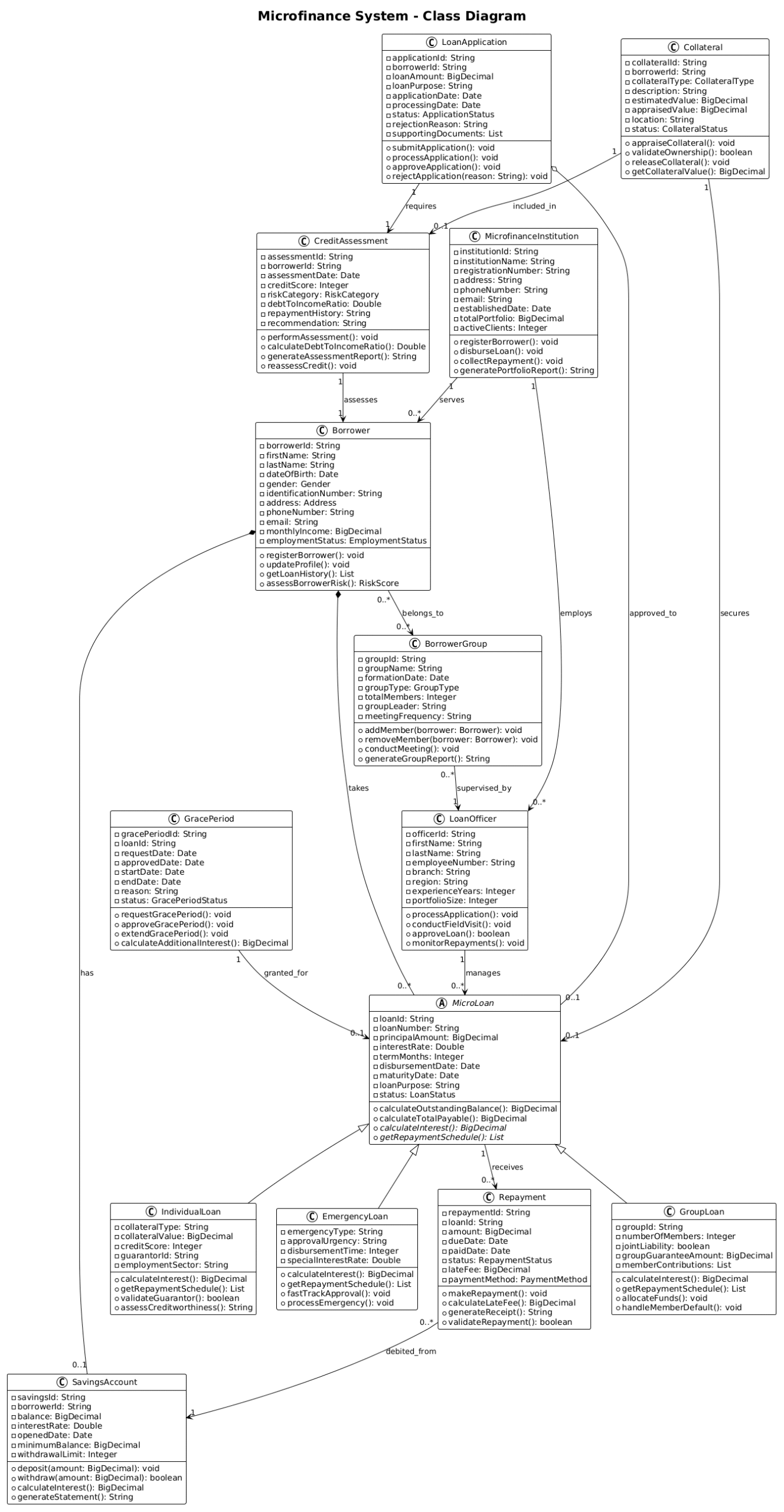 Plantuml Edit Plantuml in VPasCode
@startuml !theme plain title Microfinance System - Class Diagram ' Abstract base class abstract class MicroLoan { - loanId: String - loanNumber: String - principalAmount: BigDecimal - interestRate: Double - termMonths: Integer - disbursementDate: Date - maturityDate: Date - loanPurpose: String - status: LoanStatus + calculateOutstandingBalance(): BigDecimal + calculateTotalPayable(): BigDecimal + {abstract} calculateInterest(): BigDecimal + {abstract} getRepaymentSchedule(): List } ' Derived classes from MicroLoan class GroupLoan { - groupId: String - numberOfMembers: Integer - jointLiability: boolean - groupGuaranteeAmount: BigDecimal - memberContributions: List + calculateInterest(): BigDecimal + getRepaymentSchedule(): List + allocateFunds(): void + handleMemberDefault(): void } class IndividualLoan { - collateralType: String - collateralValue: BigDecimal - creditScore: Integer - guarantorId: String - employmentSector: String + calculateInterest(): BigDecimal + getRepaymentSchedule(): List + validateGuarantor(): boolean + assessCreditworthiness(): String } class EmergencyLoan { - emergencyType: String - approvalUrgency: String - disbursementTime: Integer - specialInterestRate: Double + calculateInterest(): BigDecimal + getRepaymentSchedule(): List + fastTrackApproval(): void + processEmergency(): void } ' Borrower class class Borrower { - borrowerId: String - firstName: String - lastName: String - dateOfBirth: Date - gender: Gender - identificationNumber: String - address: Address - phoneNumber: String - email: String - monthlyIncome: BigDecimal - employmentStatus: EmploymentStatus + registerBorrower(): void + updateProfile(): void + getLoanHistory(): List + assessBorrowerRisk(): RiskScore } ' BorrowerGroup class class BorrowerGroup { - groupId: String - groupName: String - formationDate: Date - groupType: GroupType - totalMembers: Integer - groupLeader: String - meetingFrequency: String + addMember(borrower: Borrower): void + removeMember(borrower: Borrower): void + conductMeeting(): void + generateGroupReport(): String } ' Repayment class class Repayment { - repaymentId: String - loanId: String - amount: BigDecimal - dueDate: Date - paidDate: Date - status: RepaymentStatus - lateFee: BigDecimal - paymentMethod: PaymentMethod + makeRepayment(): void + calculateLateFee(): BigDecimal + generateReceipt(): String + validateRepayment(): boolean } ' LoanOfficer class class LoanOfficer { - officerId: String - firstName: String - lastName: String - employeeNumber: String - branch: String - region: String - experienceYears: Integer - portfolioSize: Integer + processApplication(): void + conductFieldVisit(): void + approveLoan(): boolean + monitorRepayments(): void } ' SavingsAccount class class SavingsAccount { - savingsId: String - borrowerId: String - balance: BigDecimal - interestRate: Double - openedDate: Date - minimumBalance: BigDecimal - withdrawalLimit: Integer + deposit(amount: BigDecimal): void + withdraw(amount: BigDecimal): boolean + calculateInterest(): BigDecimal + generateStatement(): String } ' MicrofinanceInstitution class class MicrofinanceInstitution { - institutionId: String - institutionName: String - registrationNumber: String - address: String - phoneNumber: String - email: String - establishedDate: Date - totalPortfolio: BigDecimal - activeClients: Integer + registerBorrower(): void + disburseLoan(): void + collectRepayment(): void + generatePortfolioReport(): String } ' LoanApplication class class LoanApplication { - applicationId: String - borrowerId: String - loanAmount: BigDecimal - loanPurpose: String - applicationDate: Date - processingDate: Date - status: ApplicationStatus - rejectionReason: String - supportingDocuments: List + submitApplication(): void + processApplication(): void + approveApplication(): void + rejectApplication(reason: String): void } ' CreditAssessment class class CreditAssessment { - assessmentId: String - borrowerId: String - assessmentDate: Date - creditScore: Integer - riskCategory: RiskCategory - debtToIncomeRatio: Double - repaymentHistory: String - recommendation: String + performAssessment(): void + calculateDebtToIncomeRatio(): Double + generateAssessmentReport(): String + reassessCredit(): void } ' Collateral class class Collateral { - collateralId: String - borrowerId: String - collateralType: CollateralType - description: String - estimatedValue: BigDecimal - appraisedValue: BigDecimal - location: String - status: CollateralStatus + appraiseCollateral(): void + validateOwnership(): boolean + releaseCollateral(): void + getCollateralValue(): BigDecimal } ' GracePeriod class class GracePeriod { - gracePeriodId: String - loanId: String - requestDate: Date - approvedDate: Date - startDate: Date - endDate: Date - reason: String - status: GracePeriodStatus + requestGracePeriod(): void + approveGracePeriod(): void + extendGracePeriod(): void + calculateAdditionalInterest(): BigDecimal } ' ============ Relationships ============ ' Generalization (Inheritance) MicroLoan <|-- GroupLoan MicroLoan <|-- IndividualLoan MicroLoan <|-- EmergencyLoan ' Composition (Borrower - MicroLoan) - Strong ownership Borrower *-- "0..*" MicroLoan : takes ' Composition (Borrower - SavingsAccount) - Strong ownership Borrower *-- "0..1" SavingsAccount : has ' Association (Borrower - BorrowerGroup) - Many-to-Many Borrower "0..*" --> "0..*" BorrowerGroup : belongs_to ' Association (MicroLoan - Repayment) - One-to-Many MicroLoan "1" --> "0..*" Repayment : receives ' Association (LoanOfficer - MicroLoan) - One-to-Many LoanOfficer "1" --> "0..*" MicroLoan : manages ' Association (MicrofinanceInstitution - Borrower) - One-to-Many MicrofinanceInstitution "1" --> "0..*" Borrower : serves ' Association (MicrofinanceInstitution - LoanOfficer) - One-to-Many MicrofinanceInstitution "1" --> "0..*" LoanOfficer : employs ' Aggregation (LoanApplication - MicroLoan) - Weak ownership LoanApplication o-- "0..1" MicroLoan : approved_to ' Association (CreditAssessment - Borrower) - One-to-One CreditAssessment "1" --> "1" Borrower : assesses ' Association (Collateral - MicroLoan) - One-to-One Collateral "1" --> "0..1" MicroLoan : secures ' Association (GracePeriod - MicroLoan) - One-to-One GracePeriod "1" --> "0..1" MicroLoan : granted_for ' Association (LoanApplication - CreditAssessment) - One-to-One LoanApplication "1" --> "1" CreditAssessment : requires ' Association (BorrowerGroup - LoanOfficer) - One-to-Many BorrowerGroup "0..*" --> "1" LoanOfficer : supervised_by ' Association (Repayment - SavingsAccount) - Many-to-One Repayment "0..*" --> "1" SavingsAccount : debited_from ' Association (Collateral - CreditAssessment) - One-to-One Collateral "1" --> "0..1" CreditAssessment : included_in @endumlStep-by-Step Architectural Walkthrough
Building a robust class diagram requires a logical progression. We will construct this Microfinance System model in four distinct phases.
Phase 1: Canvas Configuration & Inheritance Hierarchy
We begin by setting the visual theme and defining the core abstraction for loans. In finance, different loan types share common attributes but have unique behaviors. We model this using Generalization (Inheritance).
First, we declare an
abstract classnamedMicroLoan. This acts as a template. It defines common fields likeprincipalAmountandinterestRate, as well as abstract methods that subclasses must implement.abstract class MicroLoan { - loanId: String - principalAmount: BigDecimal + {abstract} calculateInterest(): BigDecimal } class GroupLoan abstract class MicroLoan <|-- GroupLoanThe symbol
<|--indicates thatGroupLoaninherits fromMicroLoan, inheriting all its properties while adding specific ones likejointLiability.Phase 2: Declaring Core Entities, Actors, and Boundaries
Next, we define the primary actors and entities that drive the system. In a financial context, the
Borroweris the central entity. We also introduce theLoanOfficerand theMicrofinanceInstitutionto represent the operational side.For each class, we define attributes (private fields prefixed with
-) and methods (public functions prefixed with+). For example, theBorrowerclass includes sensitive data likeidentificationNumberandmonthlyIncome, while offering methods likeassessBorrowerRisk().class Borrower { - borrowerId: String - monthlyIncome: BigDecimal + assessBorrowerRisk(): RiskScore } class LoanOfficer { - employeeNumber: String + approveLoan(): boolean }Phase 3: Mapping Data Flows & Key Interactions
With entities defined, we must link them using relationships. This phase focuses on the Association and Composition lines that define how data is connected.
- Composition (
*--): This implies strong ownership. For example, aBorrower"owns" aSavingsAccount. If the borrower record is deleted, the account should logically be handled accordingly. - Association (
-->): This represents a weaker link. ALoanOfficermanages many loans, but the loan can exist independently of the officer.
Borrower *-- "0..1" SavingsAccount : has
LoanOfficer "1" --> "0..*" MicroLoan : manages
Notice the cardinality labels like
"0..1"(zero or one) and"0..*"(zero to many). These are critical for database constraints.Phase 4: Grouping, Annotations & Visual Polish
Finally, we add supporting modules like
Repayment,CreditAssessment, andCollateral. These classes extend the core loan functionality. We also useAggregation(o--) forLoanApplication, indicating that an application can exist without necessarily resulting in a loan (it might be rejected).LoanApplication o-- "0..1" MicroLoan : approved_toThis phase ensures the diagram captures the full lifecycle of a financial transaction, from application to disbursement and repayment.
Syntax & Keyword Deep Dive
To master PlantUML class diagrams, you must understand the specific syntax keywords used in this model.
abstract class: Defines a class that cannot be instantiated on its own. It is used here forMicroLoanto enforce a common interface for all loan types.class: The standard keyword for defining a concrete entity with specific attributes and methods.*--(Composition): A solid line with a filled diamond. Represents strong ownership (e.g.,BorrowerownsSavingsAccount).-->(Association): A solid line with an open arrow. Represents a relationship where one class references another (e.g.,LoanOfficermanagesMicroLoan).o--(Aggregation): A solid line with a hollow diamond. Represents weak ownership (e.g.,LoanApplicationmay or may not result in aMicroLoan).<|--(Generalization): A solid line with a hollow triangle. Represents inheritance (e.g.,GroupLoanextendsMicroLoan).-vs+: In the class body,-denotes private attributes, while+denotes public methods.
Best Practices & Pitfalls to Avoid
When building financial diagrams with VPasCode, keep these architectural principles in mind:
- Modularize Complex Entities: If your diagram becomes cluttered, consider breaking it into multiple files or using packages. However, for a system of this size, keeping it in one file aids quick review.
- Use Meaningful Cardinalities: Never guess. Use
"1","0..1", or"0..*"explicitly. In finance, aLoanmust have exactly oneBorrower, but aBorrowercan have zero or manyLoans. - Distinguish Ownership: Use Composition (
*--) only when lifecycle dependency is strict. Do not use it forLoanOfficerrelationships, as officers can be reassigned without destroying the loan. - Keep Attributes Type-Safe: Use precise types like
BigDecimalfor currency andDatefor timestamps. Avoid genericStringfor dates to ensure type safety in the generated documentation.
Start Building PlantUML Diagrams Faster with VPasCode
Test, preview, and customize your Microfinance System class diagram instantly in your browser without installing any tools.
- Composition (