


In the high-stakes world of finance, managing risk is not just a regulatory requirement—it is a fundamental pillar of organizational stability. Financial institutions must continuously monitor, assess, and mitigate various forms of risk, including operational errors, market volatility, and strategic misalignment. However, documenting these complex interactions in static documents often leads to ambiguity and version drift.

This is where diagram-as-code methodologies shine. By using PlantUML class diagrams, architects can define the structure of a Risk Management System in a precise, text-based format that is easy to review, edit, and render. VPasCode provides an instant, browser-based environment to visualize these models without needing local Java installations or complex build chains.
In this masterclass, we will construct a comprehensive Risk Management System class diagram. We will explore how to model abstract risk types, define control mechanisms, and map the intricate relationships between compliance requirements, incident tracking, and analytics. This visual blueprint ensures that developers and stakeholders share a unified understanding of the system’s data architecture.
Understanding the Model: Purpose, Scope & Problem Framing
Diagram Abstraction & Representation
A PlantUML class diagram serves as the structural backbone of a software system. In the context of Risk Management, it moves beyond simple entity listing to define the behavioral contract of the system. It specifies not only what data each component holds (attributes) but also how it behaves (methods).
For this architecture, the diagram models the core domain entities of a risk platform. It captures the hierarchy of risk types (Operational, Financial, Strategic), the lifecycle of a risk (from assessment to mitigation), and the governance layer (Compliance, Audit, and Analytics). By visualizing these components, architects can identify potential bottlenecks, ensure proper separation of concerns, and validate the integrity of data flows before writing a single line of production code.
Target Domain Scope & Scenario
This model focuses specifically on the Enterprise Risk Management (ERM) subsystem. The boundaries are defined to include:
- Risk Identification: How risks are categorized and scored.
- Risk Control: How mitigation strategies are planned and tracked.
- Compliance & Audit: How regulatory requirements are mapped to risks.
- Analytics & Reporting: How risk data is aggregated for dashboards.
Dependencies outside this scope, such as the specific user authentication system or the external banking APIs, are abstracted away to maintain focus on the core risk domain logic.
Key Takeaways & Educational Insights
By studying and building this diagram, you will gain:
- Inheritance Modeling: Understanding how to define a base
Riskclass and extend it for specific risk types. - Relationship Semantics: Distinguishing between Composition (strong ownership) and Aggregation (weak ownership) in financial data structures.
- Method Signatures: How to define public and private methods to enforce encapsulation.
- Visual Clarity: Using themes and grouping to make complex schemas readable.
Complete Diagram & Full Source Code
Before diving into the construction steps, here is the final architectural blueprint. This diagram encapsulates 11 distinct classes and 14 relationship lines, utilizing the aws-orange theme for a professional financial look.
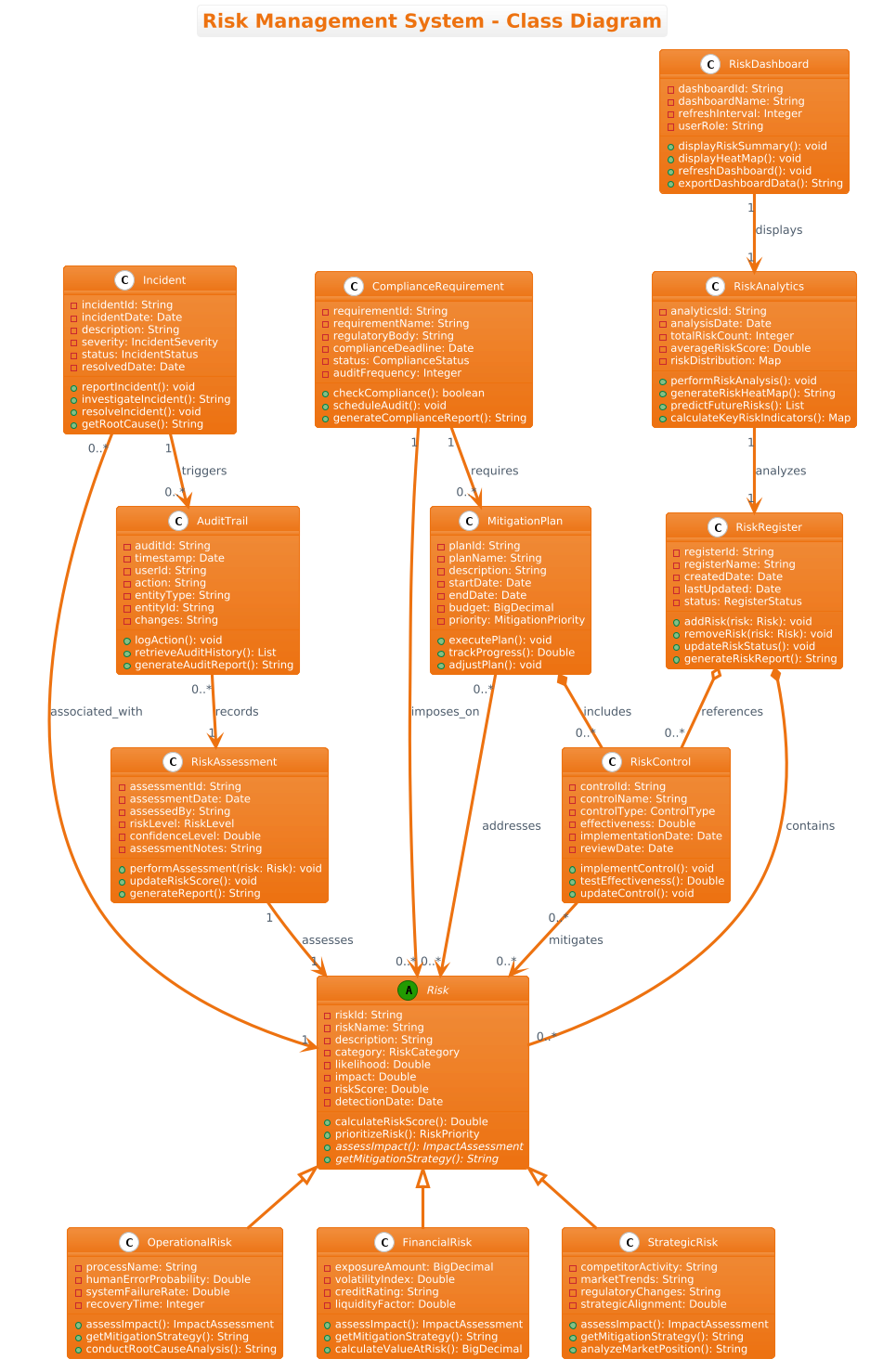
@startuml

!theme aws-orange
title Risk Management System - Class Diagram

' Abstract base class
abstract class Risk {
  - riskId: String
  - riskName: String
  - description: String
  - category: RiskCategory
  - likelihood: Double
  - impact: Double
  - riskScore: Double
  - detectionDate: Date
  + calculateRiskScore(): Double
  + prioritizeRisk(): RiskPriority
  + {abstract} assessImpact(): ImpactAssessment
  + {abstract} getMitigationStrategy(): String
}

' Derived classes from Risk
class OperationalRisk {
  - processName: String
  - humanErrorProbability: Double
  - systemFailureRate: Double
  - recoveryTime: Integer
  + assessImpact(): ImpactAssessment
  + getMitigationStrategy(): String
  + conductRootCauseAnalysis(): String
}

class FinancialRisk {
  - exposureAmount: BigDecimal
  - volatilityIndex: Double
  - creditRating: String
  - liquidityFactor: Double
  + assessImpact(): ImpactAssessment
  + getMitigationStrategy(): String
  + calculateValueAtRisk(): BigDecimal
}

class StrategicRisk {
  - competitorActivity: String
  - marketTrends: String
  - regulatoryChanges: String
  - strategicAlignment: Double
  + assessImpact(): ImpactAssessment
  + getMitigationStrategy(): String
  + analyzeMarketPosition(): String
}

' RiskAssessment class
class RiskAssessment {
  - assessmentId: String
  - assessmentDate: Date
  - assessedBy: String
  - riskLevel: RiskLevel
  - confidenceLevel: Double
  - assessmentNotes: String
  + performAssessment(risk: Risk): void
  + updateRiskScore(): void
  + generateReport(): String
}

' RiskControl class
class RiskControl {
  - controlId: String
  - controlName: String
  - controlType: ControlType
  - effectiveness: Double
  - implementationDate: Date
  - reviewDate: Date
  + implementControl(): void
  + testEffectiveness(): Double
  + updateControl(): void
}

' MitigationPlan class
class MitigationPlan {
  - planId: String
  - planName: String
  - description: String
  - startDate: Date
  - endDate: Date
  - budget: BigDecimal
  - priority: MitigationPriority
  + executePlan(): void
  + trackProgress(): Double
  + adjustPlan(): void
}

' Incident class
class Incident {
  - incidentId: String
  - incidentDate: Date
  - description: String
  - severity: IncidentSeverity
  - status: IncidentStatus
  - resolvedDate: Date
  + reportIncident(): void
  + investigateIncident(): String
  + resolveIncident(): void
  + getRootCause(): String
}

' RiskRegister class
class RiskRegister {
  - registerId: String
  - registerName: String
  - createdDate: Date
  - lastUpdated: Date
  - status: RegisterStatus
  + addRisk(risk: Risk): void
  + removeRisk(risk: Risk): void
  + updateRiskStatus(): void
  + generateRiskReport(): String
}

' RiskAnalytics class
class RiskAnalytics {
  - analyticsId: String
  - analysisDate: Date
  - totalRiskCount: Integer
  - averageRiskScore: Double
  - riskDistribution: Map
  + performRiskAnalysis(): void
  + generateRiskHeatMap(): String
  + predictFutureRisks(): List
  + calculateKeyRiskIndicators(): Map
}

' ComplianceRequirement class
class ComplianceRequirement {
  - requirementId: String
  - requirementName: String
  - regulatoryBody: String
  - complianceDeadline: Date
  - status: ComplianceStatus
  - auditFrequency: Integer
  + checkCompliance(): boolean
  + scheduleAudit(): void
  + generateComplianceReport(): String
}

' AuditTrail class
class AuditTrail {
  - auditId: String
  - timestamp: Date
  - userId: String
  - action: String
  - entityType: String
  - entityId: String
  - changes: String
  + logAction(): void
  + retrieveAuditHistory(): List
  + generateAuditReport(): String
}

' RiskDashboard class
class RiskDashboard {
  - dashboardId: String
  - dashboardName: String
  - refreshInterval: Integer
  - userRole: String
  + displayRiskSummary(): void
  + displayHeatMap(): void
  + refreshDashboard(): void
  + exportDashboardData(): String
}

' ============ Relationships ============

' Generalization (Inheritance)
Risk <|-- OperationalRisk
Risk <|-- FinancialRisk
Risk <|-- StrategicRisk

' Composition (RiskRegister - Risk) - Strong ownership
RiskRegister *-- "0..*" Risk : contains

' Composition (MitigationPlan - RiskControl) - Strong ownership
MitigationPlan *-- "0..*" RiskControl : includes

' Association (RiskAssessment - Risk) - One-to-One
RiskAssessment "1" --> "1" Risk : assesses

' Association (MitigationPlan - Risk) - Many-to-Many
MitigationPlan "0..*" --> "0..*" Risk : addresses

' Association (Incident - Risk) - Many-to-One
Incident "0..*" --> "1" Risk : associated_with

' Association (RiskAnalytics - RiskRegister) - One-to-One
RiskAnalytics "1" --> "1" RiskRegister : analyzes

' Aggregation (RiskRegister - RiskControl) - Weak ownership
RiskRegister o-- "0..*" RiskControl : references

' Association (ComplianceRequirement - Risk) - One-to-Many
ComplianceRequirement "1" --> "0..*" Risk : imposes_on

' Association (AuditTrail - RiskAssessment) - One-to-Many
AuditTrail "0..*" --> "1" RiskAssessment : records

' Association (RiskDashboard - RiskAnalytics) - One-to-One
RiskDashboard "1" --> "1" RiskAnalytics : displays

' Association (ComplianceRequirement - MitigationPlan) - One-to-Many
ComplianceRequirement "1" --> "0..*" MitigationPlan : requires

' Association (Incident - AuditTrail) - One-to-Many
Incident "1" --> "0..*" AuditTrail : triggers

' Association (RiskControl - Risk) - Many-to-Many
RiskControl "0..*" --> "0..*" Risk : mitigates

@endumlStep-by-Step Architectural Walkthrough
Building a robust class diagram requires a phased approach. We will construct this Risk Management System model in four logical stages: setup, core entities, management logic, and relationship mapping.
Phase 1: Canvas Configuration & Layout Directives
Every PlantUML diagram begins with directives that set the rendering engine and visual style. For a finance-focused diagram, we want a clean, professional look that aligns with enterprise branding.
First, we declare the diagram type and apply the theme. The !theme aws-orange directive applies a warm, authoritative color palette suitable for financial reporting.
@startuml

!theme aws-orange
title Risk Management System - Class Diagram
The @startuml directive signals the beginning of the PlantUML script, and the title command adds a caption above the rendered diagram, providing immediate context for viewers.
Phase 2: Declaring Core Entities, Actors, and Boundaries
The heart of the Risk Management System is the Risk entity. Since risks vary significantly by type, we model this as an abstract class. This allows us to define common attributes (like riskScore) while forcing subclasses to implement specific logic.
abstract class Risk {
  - riskId: String
  - riskName: String
  - description: String
  - category: RiskCategory
  - likelihood: Double
  - impact: Double
  - riskScore: Double
  - detectionDate: Date
  + calculateRiskScore(): Double
  + prioritizeRisk(): RiskPriority
  + {abstract} assessImpact(): ImpactAssessment
  + {abstract} getMitigationStrategy(): String
}
We then define the concrete subclasses: OperationalRisk, FinancialRisk, and StrategicRisk. Each inherits the core attributes of Risk but adds domain-specific fields (e.g., volatilityIndex for Financial Risk) and implements the abstract methods.
Phase 3: Mapping Data Flows & Key Interactions
Beyond the risk entities themselves, the system requires management and governance layers. We model the RiskRegister as the central repository that holds all active risks. We also define RiskAssessment, RiskControl, and MitigationPlan to handle the lifecycle of risk treatment.
class RiskRegister {
  - registerId: String
  - registerName: String
  - createdDate: Date
  - lastUpdated: Date
  - status: RegisterStatus
  + addRisk(risk: Risk): void
  + removeRisk(risk: Risk): void
  + updateRiskStatus(): void
  + generateRiskReport(): String
}
Notice the methods here. They define the public API of the RiskRegister, showing that it can add, remove, and report on risks. This encapsulation is crucial for maintaining data integrity in a finance application.
Phase 4: Grouping, Annotations & Visual Polish
The final phase involves connecting the classes. Relationships are drawn using arrows with specific symbols to denote the nature of the connection. We use *-- for Composition (strong ownership), o-- for Aggregation (weak ownership), and --> for Association.
' Composition (RiskRegister - Risk) - Strong ownership
RiskRegister *-- "0..*" Risk : contains

' Association (RiskAssessment - Risk) - One-to-One
RiskAssessment "1" --> "1" Risk : assesses

' Aggregation (RiskRegister - RiskControl) - Weak ownership
RiskRegister o-- "0..*" RiskControl : references
Labels like : contains or : assesses provide semantic meaning to the lines, making the diagram self-documenting. Cardinalities like "0..*" (zero to many) ensure developers understand the multiplicity constraints.
Syntax & Keyword Deep Dive
To fully leverage PlantUML for diagram-as-code, you must understand the specific syntax used in this Risk Management System model. Here is a breakdown of the critical keywords and arrow conventions.
abstract class: Defines a class that cannot be instantiated directly. It serves as a template for subclasses. In our diagram,Riskis abstract because you cannot have a generic “Risk” without specifying its type.class: The standard declaration for a concrete entity. Used forOperationalRisk,RiskRegister, etc.+(Public) /-(Private): Access modifiers.+indicates public methods visible to other classes, while-hides attributes from direct access, enforcing encapsulation.type: DataType: Defines the data type of an attribute (e.g.,String,Double,BigDecimal,Date). UsingBigDecimalfor financial amounts is critical for precision.<|--(Inheritance): The generalization arrow pointing from subclass to superclass. Used forRisk <|-- OperationalRisk.*--(Composition): A filled diamond indicating strong ownership. If the parent dies, the child dies. Used forRiskRegister *-- Risk.o--(Aggregation): A hollow diamond indicating weak ownership. The child can exist independently of the parent. Used forRiskRegister o-- RiskControl.-->(Association): A simple line with an arrow indicating a dependency or relationship without ownership. Used forRiskAssessment --> Risk.: Label: Text placed after the relationship arrow to describe the nature of the link (e.g.,: assesses,: mitigates)."0..*"(Cardinality): Defines the number of instances allowed on a side of a relationship."0..*"means zero or more.
Best Practices & Pitfalls to Avoid
Creating a clear and maintainable class diagram requires discipline. Here are three best practices to ensure your VPasCode diagrams remain effective over time.
- Maintain Abstraction Levels: Do not mix high-level business entities with low-level database implementation details. For example, keep
Riskas a business object rather than mapping it directly to SQL tables unless you are creating a specific data model diagram. - Use Descriptive Relationship Labels: Never leave relationship lines unlabeled. A line between
IncidentandRiskcould mean “caused by,” “associated with,” or “resolved for.” Always use a label like: associated_withto clarify intent. - Group Related Classes: While PlantUML allows free positioning, logical grouping helps readability. Use
packagestatements or visual clustering if the diagram grows larger than 20 classes. For this Risk Management System, the hierarchy is clear enough without explicit packages, but the thematic grouping (Risk, Control, Analytics) is visually distinct.
Try It Yourself with VPasCode
Start Building PlantUML Class Diagrams Faster with VPasCode
Design, preview, and refine your Risk Management System architecture instantly in the browser—no installation required.