


In the complex landscape of modern manufacturing and enterprise logistics, clarity is currency. An Enterprise Resource Planning (ERP) system acts as the central nervous system of an organization, integrating core functions like supply chain, finance, human resources, and production into a unified data model. However, the sheer scale of these systems often leads to fragmented documentation and misaligned development efforts.

Visual modeling bridges this gap. By translating abstract business requirements into a static structure diagram, architects can validate data consistency and transactional integrity before writing a single line of production code. This is where diagramming-as-code with PlantUML shines. It allows teams to treat their architectural blueprints as living documentation that evolves alongside the software.
Using VPasCode, the free web-based diagram-as-code editor, engineers can prototype these complex domain models instantly. There is no need for local Java installations or heavy IDE plugins. This tutorial serves as a masterclass on constructing a comprehensive ERP Class Diagram, demonstrating how to model inheritance, aggregation, and composition to create a scalable system architecture.
Understanding the Model: Purpose, Scope & Problem Framing
Diagram Abstraction & Representation
A Class Diagram is the cornerstone of object-oriented design. In the context of an ERP system, it does not model behavior or timing; instead, it defines the static structure of the data. It answers the question: “What objects exist in this system, and how do they relate to one another?”.
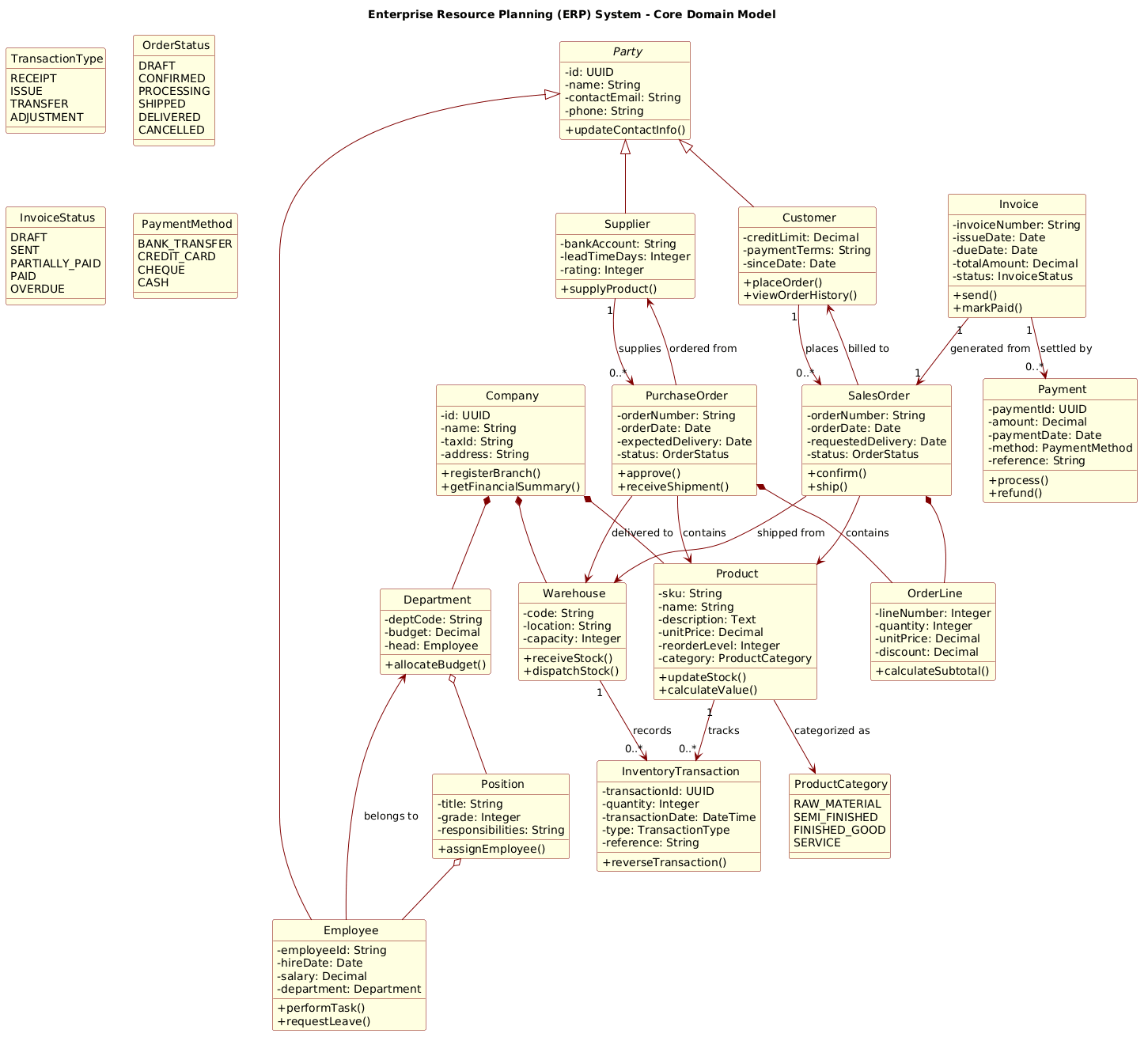
Entities like Customer, Product, and Employee represent the fundamental nouns of the business domain. Relationships like Composition (strong ownership) and Aggregation (weak ownership) define the lifecycle and dependency of these objects. For instance, an OrderLine cannot exist without an Order, suggesting a composition relationship, whereas an Employee might move between departments, suggesting an aggregation.
Target Domain Scope & Scenario
This model focuses on the Core Domain of a manufacturing ERP. It intentionally excludes peripheral systems like email notifications or third-party logistics APIs to maintain clarity. The scope covers:
- Operational Modules: Order Management, Inventory Control, Procurement.
- Financial Integration: Invoicing and Payment tracking.
- Organizational Structure: Departments, Employees, and Positions.
By limiting the scope to these core entities, we ensure the diagram remains a navigable blueprint rather than an overwhelming map of every microservice.
Key Takeaways & Educational Insights
By following this guide, you will gain insights into:
- Domain-Driven Design (DDD): How to align code structure with business terminology.
- Relationship Granularity: When to use Composition vs. Association.
- Abstraction Levels: How to use Abstract Classes (like
Party) to reduce redundancy.
Complete Diagram & Full Source Code
Before diving into the construction phases, visualize the end goal. Below is the complete ERP System Core Domain Model. This diagram utilizes the Rose theme for a professional aesthetic and includes a comprehensive set of classes, enums, and relationships.
@startuml
!include https://static.visual-paradigm.com/web/resources/plantuml-stdlib/themes/rose.puml

title Enterprise Resource Planning (ERP) System – Core Domain Model

/'
This class diagram models the foundational domain structure of a typical ERP system.
It captures the primary business entities involved in managing supply chain, inventory,
sales, procurement, finance, and human resources within an enterprise.

The diagram illustrates how key operational modules (Order Management, Inventory,
Procurement, Production, Financials, and HR) interrelate through various class
relationships. Central entities such as Product, Warehouse, PurchaseOrder, and
SalesOrder coordinate to track goods and transactions. Financial records (Invoice,
Payment) are linked to orders and customers/suppliers. Employee and Department
represent the organizational structure, while roles and responsibilities are defined
through position-based associations.

This abstraction serves as a blueprint for designing an integrated ERP system
where data consistency, traceability, and transactional integrity are paramount.
The model emphasizes both structural composition (e.g., Order → OrderLine)
and behavioral dependencies (e.g., InventoryTransaction updates Product stock).
'/

class Company {
  - id: UUID
  - name: String
  - taxId: String
  - address: String
  + registerBranch()
  + getFinancialSummary()
}

abstract class Party {
  - id: UUID
  - name: String
  - contactEmail: String
  - phone: String
  + updateContactInfo()
}

class Customer {
  - creditLimit: Decimal
  - paymentTerms: String
  - sinceDate: Date
  + placeOrder()
  + viewOrderHistory()
}

class Supplier {
  - bankAccount: String
  - leadTimeDays: Integer
  - rating: Integer
  + supplyProduct()
}

class Employee {
  - employeeId: String
  - hireDate: Date
  - salary: Decimal
  - department: Department
  + performTask()
  + requestLeave()
}

class Department {
  - deptCode: String
  - budget: Decimal
  - head: Employee
  + allocateBudget()
}

class Position {
  - title: String
  - grade: Integer
  - responsibilities: String
  + assignEmployee()
}

class Product {
  - sku: String
  - name: String
  - description: Text
  - unitPrice: Decimal
  - reorderLevel: Integer
  - category: ProductCategory
  + updateStock()
  + calculateValue()
}

enum ProductCategory {
  RAW_MATERIAL
  SEMI_FINISHED
  FINISHED_GOOD
  SERVICE
}

class Warehouse {
  - code: String
  - location: String
  - capacity: Integer
  + receiveStock()
  + dispatchStock()
}

class InventoryTransaction {
  - transactionId: UUID
  - quantity: Integer
  - transactionDate: DateTime
  - type: TransactionType
  - reference: String
  + reverseTransaction()
}

enum TransactionType {
  RECEIPT
  ISSUE
  TRANSFER
  ADJUSTMENT
}

class PurchaseOrder {
  - orderNumber: String
  - orderDate: Date
  - expectedDelivery: Date
  - status: OrderStatus
  + approve()
  + receiveShipment()
}

class SalesOrder {
  - orderNumber: String
  - orderDate: Date
  - requestedDelivery: Date
  - status: OrderStatus
  + confirm()
  + ship()
}

enum OrderStatus {
  DRAFT
  CONFIRMED
  PROCESSING
  SHIPPED
  DELIVERED
  CANCELLED
}

class OrderLine {
  - lineNumber: Integer
  - quantity: Integer
  - unitPrice: Decimal
  - discount: Decimal
  + calculateSubtotal()
}

class Invoice {
  - invoiceNumber: String
  - issueDate: Date
  - dueDate: Date
  - totalAmount: Decimal
  - status: InvoiceStatus
  + send()
  + markPaid()
}

enum InvoiceStatus {
  DRAFT
  SENT
  PARTIALLY_PAID
  PAID
  OVERDUE
}

class Payment {
  - paymentId: UUID
  - amount: Decimal
  - paymentDate: Date
  - method: PaymentMethod
  - reference: String
  + process()
  + refund()
}

enum PaymentMethod {
  BANK_TRANSFER
  CREDIT_CARD
  CHEQUE
  CASH
}

' Generalization (inheritance)
Party <|-- Customer
Party <|-- Supplier
Party <|-- Employee

' Composition (strong ownership)
Company *-- Department
Company *-- Warehouse
Company *-- Product

PurchaseOrder *-- OrderLine
SalesOrder *-- OrderLine

' Aggregation (weaker container)
Department o-- Position
Position o-- Employee

' Association (bi-directional)
Customer "1" --> "0..*" SalesOrder : places
Supplier "1" --> "0..*" PurchaseOrder : supplies
Warehouse "1" --> "0..*" InventoryTransaction : records
Product "1" --> "0..*" InventoryTransaction : tracks

PurchaseOrder --> Supplier : ordered from
PurchaseOrder --> Warehouse : delivered to
SalesOrder --> Customer : billed to
SalesOrder --> Warehouse : shipped from

Invoice "1" --> "1" SalesOrder : generated from
Invoice "1" --> "0..*" Payment : settled by

PurchaseOrder --> Product : contains
SalesOrder --> Product : contains

Product --> ProductCategory : categorized as

Employee --> Department : belongs to
@endumlStep-by-Step Architectural Walkthrough
Phase 1: Canvas Configuration & Layout Directives
Every professional diagram begins with a consistent visual theme. In VPasCode, we can include standard libraries to apply polished aesthetics without manual CSS. We start by including the Rose theme, which provides a clean, corporate look suitable for enterprise documentation.
!include https://static.visual-paradigm.com/web/resources/plantuml-stdlib/themes/rose.pumlNext, we define the diagram’s identity. A title directive ensures the diagram is self-explanatory when shared. Following the title, we add a comment block using /' and '/. This is critical for living documentation; it allows you to describe the architectural intent without cluttering the syntax.
title Enterprise Resource Planning (ERP) System – Core Domain Model

/'
This class diagram models the foundational domain structure...
'/
Phase 2: Declaring Core Entities, Actors, and Boundaries
We begin modeling the fundamental nouns of the system. In ERP systems, data duplication is a major risk. To solve this, we use an abstract class named Party. This acts as a parent for Customer, Supplier, and Employee, capturing shared attributes like name and contactEmail.
abstract class Party {
  - id: UUID
  - name: String
  - contactEmail: String
  - phone: String
  + updateContactInfo()
}
We then define specific entities. Notice the use of specific data types like UUID, Decimal, and DateTime. This precision helps developers implement the backend logic correctly. We also define Company as the root entity that aggregates critical resources like Warehouse and Product.
Phase 3: Mapping Data Flows & Key Interactions
Once entities are defined, we map the relationships. This phase is about defining cardinality and ownership.
1. Order Management: An Order is composed of multiple OrderLine items. If the Order is deleted, the Lines should logically vanish. This is a Composition relationship.
PurchaseOrder *-- OrderLine
SalesOrder *-- OrderLine
2. Inventory Tracking: A Warehouse records many InventoryTransaction events. However, a transaction can exist conceptually as a log entry even if the warehouse is reorganized. This suggests an Association.
Warehouse "1" --> "0..*" InventoryTransaction : recordsPhase 4: Grouping, Annotations & Visual Polish
To enhance readability, we utilize enum types for status codes and categories. Instead of using strings for status or category, we define strict enumerations like OrderStatus or ProductCategory. This prevents invalid states in the application logic.
enum OrderStatus {
  DRAFT
  CONFIRMED
  PROCESSING
  SHIPPED
  DELIVERED
  CANCELLED
}
We also add role labels to associations (e.g., places, supplies) to make the diagram readable as a natural language sentence. Finally, we ensure all relationships are explicitly drawn using PlantUML arrow syntax.
Syntax & Keyword Deep Dive
Understanding the specific syntax of PlantUML is essential for mastering diagram-as-code. Here are the key keywords used in this ERP model:
abstract class: Defines a class that cannot be instantiated on its own. It serves as a blueprint for subclasses (e.g.,Party).enum: Defines a fixed set of values. Used for statuses likeOrderStatusto enforce data integrity.<|--: Represents Generalization (Inheritance). The arrow points from the subclass to the superclass.*--: Represents Composition. The filled diamond indicates strong ownership (e.g.,OrderownsOrderLine).o--: Represents Aggregation. The hollow diamond indicates weak ownership (e.g.,DepartmentcontainsPosition).-->: Represents Association. A standard line indicating a relationship between two entities."1" --> "0..*": Defines Cardinality. “1” means one, “0..*” means zero or more.
Best Practices & Pitfalls to Avoid
When modeling complex systems like ERP in VPasCode, adhere to these principles:
- Maintain Abstraction Levels: Do not mix UI elements with domain classes. Keep the diagram focused on data structure and business logic.
- Consistent Naming: Use PascalCase for Classes and Enums, and camelCase for methods/attributes to align with standard coding conventions.
- Limit Relationship Complexity: Avoid overly dense diagrams. If a diagram becomes unreadable, consider splitting it into sub-diagrams (e.g., one for HR, one for Finance).
- Document Intent: Always use the comment block to explain why a relationship exists, not just what it is.
Try It Yourself with VPasCode
Start Building PlantUML Class Diagrams Faster with VPasCode
Instantly prototype, preview, and customize your ERP architecture models online without installing any tools or configuring local environments.