


In the realm of public library logistics, the mobile book unit serves as a vital lifeline, extending services to remote communities and underserved neighborhoods. However, managing the intricate data flows required to operate these units—tracking routes, scheduling stops, managing book inventory across multiple physical copies, and fulfilling patron holds—presents a significant data modeling challenge. A static spreadsheet or a simple list of tasks is insufficient; the system requires a robust, relational data model that can handle the dynamic interplay between mobile assets, staff assignments, and patron requests.

This tutorial demonstrates how to architect a professional Entity-Relationship Diagram (ERD) specifically designed for a Library Book Mobile Unit Route Planning and Patron Hold Delivery System. By leveraging PlantUML within the VPasCode editor, we can define the core entities—Patrons, Books, Routes, Stops, and Holds—and visualize their cardinalities and relationships in real-time. This approach ensures that the database schema supports critical operational queries, such as “Which books are available for pickup at the next stop?” or “What is the optimal route for a specific mobile unit?”, while maintaining data integrity across the entire logistics network.
Understanding the Model: Purpose, Scope & Problem Framing
Diagram Abstraction & Representation
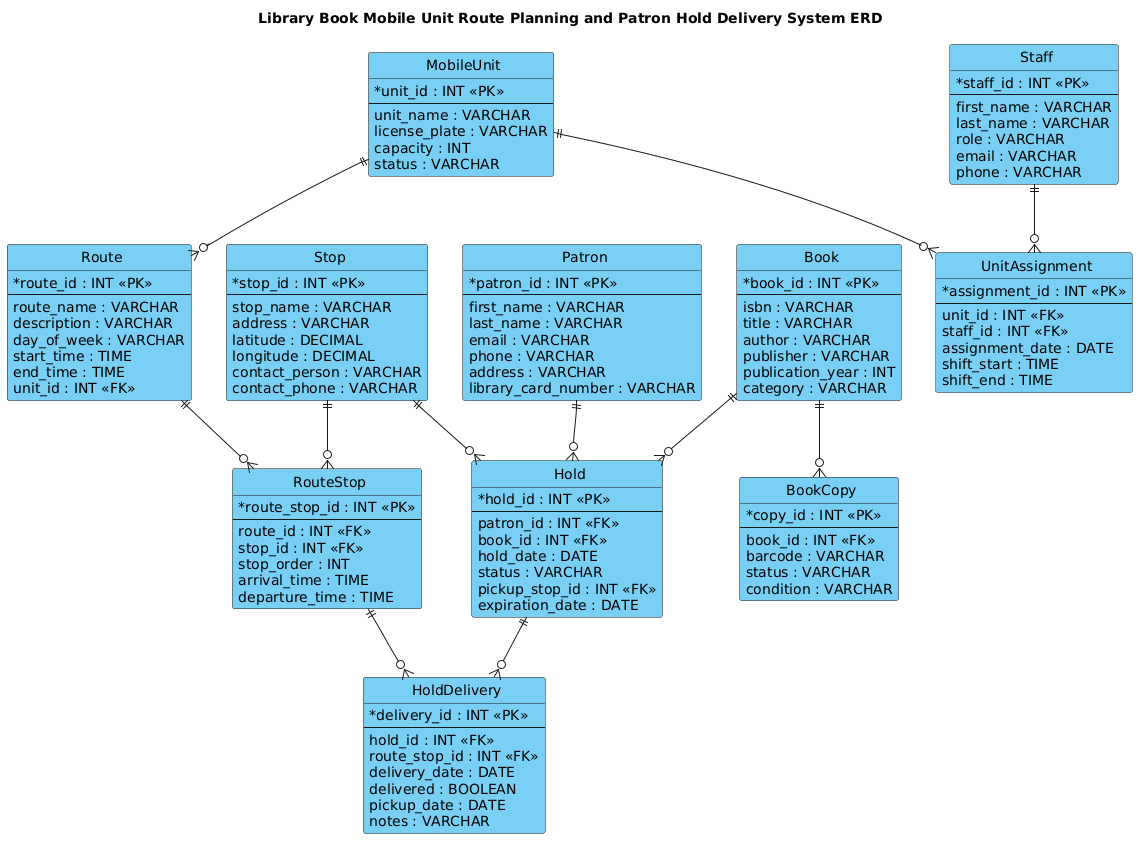
An Entity-Relationship Diagram (ERD) is the blueprint for relational databases, defining how data is structured and related. In this specific context, the ERD abstracts the physical world of a mobile library into digital entities. The Patron entity represents the user, while the Book and BookCopy entities distinguish between the intellectual property (the title) and the physical asset (the specific copy with a barcode). The Route and Stop entities model the geographic and temporal constraints of the mobile unit’s journey, while the Hold and HoldDelivery entities capture the transactional flow of a book request from initiation to fulfillment.
Target Domain Scope & Scenario
The scope of this diagram covers the end-to-end lifecycle of a mobile library service. It explicitly models the relationship between a MobileUnit and the Route it travels, the Stops it visits, and the Staff assigned to operate it. Crucially, it addresses the logistics of hold fulfillment: a patron places a hold, which is then linked to a specific RouteStop for pickup. This scope excludes internal library cataloging details (like Dewey Decimal classification logic) and focuses purely on the operational data required to move books from the central library to the mobile unit and finally to the patron.
Key Takeaways & Educational Insights
By constructing this diagram, you will gain insights into:
- Normalization: How to separate Book metadata from BookCopy physical attributes to avoid data redundancy.
- Associative Entities: The necessity of the RouteStop and HoldDelivery tables to resolve many-to-many relationships between routes, stops, and holds.
- Temporal Data: The importance of tracking stop_order, arrival_time, and pickup_date to manage the time-sensitive nature of mobile logistics.
Complete Diagram & Full Source Code
Below is the finalized Entity-Relationship Diagram, rendered directly from the PlantUML code. This visual representation clearly maps the primary keys (PK), foreign keys (FK), and the directional relationships that govern the system’s data integrity.
@startuml
!include https://static.visual-paradigm.com/web/resources/plantuml-stdlib/themes/vp.puml

title Library Book Mobile Unit Route Planning and Patron Hold Delivery System ERD

/'
This ERD models the core data structures needed to plan mobile library routes and deliver
patron holds. A mobile unit travels along defined routes on scheduled stops, and each stop
is associated with a specific branch or community location. Patrons place holds on books;
those holds are assigned to a mobile unit stop for pickup. The diagram captures the
relationships between patrons, books, holds, routes, stops, mobile units, and staff,
supporting both route planning and hold fulfillment.
'/

entity "Patron" as patron {
  * patron_id : INT <<PK>>
  --
  first_name : VARCHAR
  last_name : VARCHAR
  email : VARCHAR
  phone : VARCHAR
  address : VARCHAR
  library_card_number : VARCHAR
}

entity "Book" as book {
  * book_id : INT <<PK>>
  --
  isbn : VARCHAR
  title : VARCHAR
  author : VARCHAR
  publisher : VARCHAR
  publication_year : INT
  category : VARCHAR
}

entity "BookCopy" as book_copy {
  * copy_id : INT <<PK>>
  --
  book_id : INT <<FK>>
  barcode : VARCHAR
  status : VARCHAR
  condition : VARCHAR
}

entity "Hold" as hold {
  * hold_id : INT <<PK>>
  --
  patron_id : INT <<FK>>
  book_id : INT <<FK>>
  hold_date : DATE
  status : VARCHAR
  pickup_stop_id : INT <<FK>>
  expiration_date : DATE
}

entity "MobileUnit" as mobile_unit {
  * unit_id : INT <<PK>>
  --
  unit_name : VARCHAR
  license_plate : VARCHAR
  capacity : INT
  status : VARCHAR
}

entity "Route" as route {
  * route_id : INT <<PK>>
  --
  route_name : VARCHAR
  description : VARCHAR
  day_of_week : VARCHAR
  start_time : TIME
  end_time : TIME
  unit_id : INT <<FK>>
}

entity "Stop" as stop {
  * stop_id : INT <<PK>>
  --
  stop_name : VARCHAR
  address : VARCHAR
  latitude : DECIMAL
  longitude : DECIMAL
  contact_person : VARCHAR
  contact_phone : VARCHAR
}

entity "RouteStop" as route_stop {
  * route_stop_id : INT <<PK>>
  --
  route_id : INT <<FK>>
  stop_id : INT <<FK>>
  stop_order : INT
  arrival_time : TIME
  departure_time : TIME
}

entity "HoldDelivery" as hold_delivery {
  * delivery_id : INT <<PK>>
  --
  hold_id : INT <<FK>>
  route_stop_id : INT <<FK>>
  delivery_date : DATE
  delivered : BOOLEAN
  pickup_date : DATE
  notes : VARCHAR
}

entity "Staff" as staff {
  * staff_id : INT <<PK>>
  --
  first_name : VARCHAR
  last_name : VARCHAR
  role : VARCHAR
  email : VARCHAR
  phone : VARCHAR
}

entity "UnitAssignment" as unit_assignment {
  * assignment_id : INT <<PK>>
  --
  unit_id : INT <<FK>>
  staff_id : INT <<FK>>
  assignment_date : DATE
  shift_start : TIME
  shift_end : TIME
}

patron ||--o{ hold
book ||--o{ hold
book ||--o{ book_copy
hold ||--o{ hold_delivery
stop ||--o{ hold
route ||--o{ route_stop
stop ||--o{ route_stop
mobile_unit ||--o{ route
route_stop ||--o{ hold_delivery
mobile_unit ||--o{ unit_assignment
staff ||--o{ unit_assignment

@endumlStep-by-Step Architectural Walkthrough
Building this ERD requires a logical progression from defining the core actors to establishing the complex logistical links between them. We will break this down into four distinct phases.
Phase 1: Canvas Configuration & Layout Directives
Before defining any entities, we must set the stage for the diagram. We start by including the VPasCode standard library theme to ensure professional styling. The @startuml directive marks the beginning of the code block.
@startuml
!include https://static.visual-paradigm.com/web/resources/plantuml-stdlib/themes/vp.puml

title Library Book Mobile Unit Route Planning and Patron Hold Delivery System ERD
We also add a comment block using /' and '/ to document the business context. This is not rendered in the diagram but serves as vital documentation for future developers.
/'
This ERD models the core data structures needed to plan mobile library routes and deliver
patron holds...
'/
Phase 2: Declaring Core Entities, Actors, and Boundaries
The foundation of the system consists of the core entities: Patron, Book, and MobileUnit. In PlantUML, we use the entity keyword to define these tables. We must explicitly define Primary Keys (PK) using * and Foreign Keys (FK) using FK.
entity "Patron" as patron {
* patron_id : INT <>
--
first_name : VARCHAR
last_name : VARCHAR
email : VARCHAR
phone : VARCHAR
address : VARCHAR
library_card_number : VARCHAR
}
entity "Book" as book {
* book_id : INT < >
--
isbn : VARCHAR
title : VARCHAR
author : VARCHAR
publisher : VARCHAR
publication_year : INT
category : VARCHAR
}
Notice the separation of Book and BookCopy. The Book entity holds static metadata (title, author), while BookCopy holds instance-specific data (barcode, condition). This is a standard normalization practice to prevent data redundancy.
Phase 3: Mapping Data Flows & Key Interactions
The complexity of the mobile unit system lies in the relationships between the route, stops, and holds. We need an associative entity, RouteStop, to link a Route to a Stop because a route can have many stops, and a stop can be visited by many routes on different days.
entity "RouteStop" as route_stop {
* route_stop_id : INT <>
--
route_id : INT <>
stop_id : INT < >
stop_order : INT
arrival_time : TIME
departure_time : TIME
}
Similarly, the HoldDelivery entity bridges the gap between a Hold and a RouteStop, recording exactly when a specific book was delivered at a specific location.
Phase 4: Grouping, Annotations & Visual Polish
Finally, we define the relationships using the ||--o{ syntax. This notation indicates a one-to-many relationship where the entity on the left (the “one” side) can have zero or many instances on the right (the “many” side). For example, a Patron can have zero or many Hold records.
patron ||--o{ hold
book ||--o{ hold
mobile_unit ||--o{ route
route ||--o{ route_stop
stop ||--o{ route_stop
We also link Staff to MobileUnit via the UnitAssignment entity, allowing for flexible shift scheduling where a staff member might work on different units on different days.
Syntax & Keyword Deep Dive
To master PlantUML ERD modeling, it is essential to understand the specific syntax elements used in this diagram:
entity "Name" as alias: Defines a new table. Thealiasis a shorter identifier used in relationship definitions, while the"Name"is the display label.* field_name : TYPE: The asterisk*denotes a Primary Key. TheTYPEspecifies the data type (e.g.,INT,VARCHAR,DATE).<and> <: These stereotypes explicitly mark Primary Keys and Foreign Keys, ensuring the generated diagram clearly identifies relational constraints.> ||--o{: This is the cardinality notation.||represents “one and only one” (mandatory), ando{represents “zero or many” (optional). This creates the crow’s foot notation on the right side of the line.--: Used within an entity block to separate the header (keys) from the body (attributes), improving visual readability./'…'/: The comment delimiter in PlantUML. It allows you to embed text descriptions directly in the code without rendering them as part of the diagram structure.
Best Practices & Pitfalls to Avoid
When modeling complex logistics systems like the mobile library unit, adhere to these best practices to ensure your diagram remains maintainable and accurate:
- Normalize Your Data: Avoid storing the same book title in every row of a BookCopy table. Always separate static metadata (Book) from instance data (BookCopy) to reduce redundancy and update anomalies.
- Use Associative Entities: When two entities have a many-to-many relationship (e.g., Routes and Stops), do not try to link them directly. Create a junction table (like RouteStop) to hold the relationship and any additional attributes (like
stop_orderorarrival_time). - Consistent Naming Conventions: Use singular names for entities (e.g.,
Patroninstead ofPatrons) and snake_case or camelCase for attributes. This consistency makes the diagram easier to read and translates more cleanly into SQL code. - Document Cardinality Clearly: Always use explicit cardinality markers (
||--o{) rather than plain lines. Ambiguity in whether a relationship is mandatory or optional can lead to significant database design flaws.
Start Building PlantUML ERDs Faster with VPasCode
Design your next database schema instantly with our free PlantUML editor, featuring live preview, zero installation, and interactive syntax testing.