


Nein, UML-Diagramme (Unified Modeling Language) sind nicht nur für die objektorientierte Programmierung (OOP) gedacht.Obwohl UML ursprünglich mit OOP-Prinzipien im Sinn entwickelt wurde, hat es sich zu einem vielseitigen Standard zur Visualisierung von Systemen über moderne Software-Paradigmen hinweg entwickelt, einschließlich funktionaler Programmierung, relationaler Datenbankdesigns, Microservices und DevOps-Infrastruktur. Das Verständnis, wie man UML außerhalb des traditionellen OOP einsetzt, ermöglicht Entwicklungsteams, komplexe Softwarearchitekturen effizient mit modernen Praktiken wie „Diagramm als Code” zu dokumentieren.”Diagramm als Code.
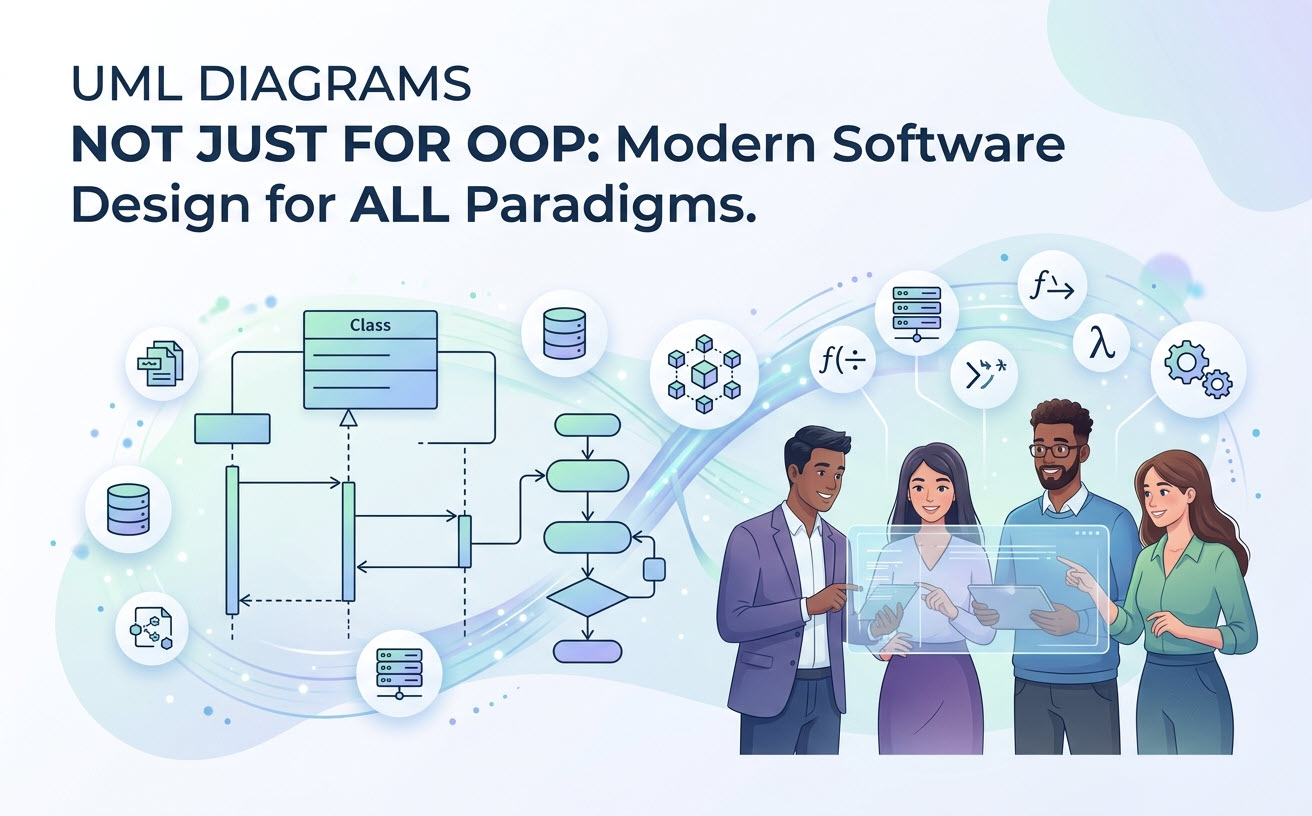
Das Missverständnis: Warum UML streng mit OOP assoziiert wird
Die Annahme, dass UML ausschließlich für OOP gedacht ist, geht auf seine Geschichte zurück. Mitte der 1990er Jahre von Grady Booch, Ivar Jacobson und James Rumbaugh („Die drei Freunde”) entwickelt, vereinte UML mehrere objektorientierte Modellierungsmethoden. Folglich spiegeln grundlegende visuelle UML-Strukturen – wie Klassendiagramme und Vererbungspfeile – zentrale OOP-Konstrukte wie Klassen, Schnittstellen und Polymorphismus wider.
Die Einschränkung von UML ausschließlich auf OOP ignoriert jedoch mehr als die Hälfte der UML-Spezifikation. UML 2.5 definiert 14 verschiedene Diagrammtypen, die in zwei Hauptgruppen unterteilt sind:
- Strukturelle Diagramme:Stellen statische Aspekte eines Systems dar (z. B. Klassen-, Komponenten-, Bereitstellungs- und Paketdiagramme).
- Verhaltensdiagramme:Stellen dynamische Interaktionen und Zustandsänderungen dar (z. B. Sequenz-, Aktivitäts-, Zustandsautomaten- und Use-Case-Diagramme).
Während strukturelle Diagramme wie Klassendiagramme eng mit OOP-Code übereinstimmen, beschreiben Verhaltensdiagramme Workflow-Logik, Netzwerkkommunikation und Ausführungsreihenfolge – Konzepte, die in allenSoftware-Paradigmen verbreitet sind.
Jenseits von OOP: Wie nicht-OOP-Paradigmen UML nutzen
Ingenieure wenden UML routinemäßig an, um visuelle Dokumentationsherausforderungen in nicht-objektorientierten Frameworks und modernen Technologie-Stacks zu lösen.
1. Funktionale und prozedurale Programmierung
Funktionale Programmierung legt den Schwerpunkt auf unveränderliche Daten und reine Funktionspipelines statt auf Objekte. Sie können diese Systeme leicht mit spezifischen UML-Verhaltensdiagrammen abbilden:
- Aktivitätsdiagramme:Modellieren Sie den Datenfluss durch reine Funktionen, Verzweigungsbedingungen und parallele Verarbeitungsströme.
- Sequenzdiagramme:Veranschaulichen Sie Funktionsaufrufstapel, asynchrone Nachrichtenübermittlung und die Ausführungsreihenfolge von Ereignissen, ohne von zugrunde liegenden Objektinstanzen auszugehen.
2. Datenbankdesign und Entity-Relationship-Modellierung
Relationale Datenbanken stützen sich auf relationale Algebra statt auf Objektvererbung. Trotz dessen funktioniert die UML-Klassen- und Objekt-Notation nahtlos für die Schema-Architektur:
| UML-Element | Datenbank-Äquivalent | Anwendung |
|---|---|---|
| Klasse | Datenbanktabelle | Definiert die Schemastruktur |
| Attribut | Spalte / Feld | Gibt Datentypen und Einschränkungen an |
| Assoziation | Fremdschlüssel-Beziehung | Macht 1:1-, 1:N- und N:M-Tabellenverbindungen sichtbar |
3. Microservices, DevOps und Systemarchitektur
Moderne Microservice-Architekturen kombinieren mehrere Sprachen – Go, Rust, Node.js und Python – in verteilten Systemen. UML-Diagramme auf Systemebene abstrahieren Code-Details vollständig:
- Komponentendiagramme:Definieren Sie API-Gateways, Nachrichtenwarteschlangen (Kafka, RabbitMQ) und Microservice-Grenzen.
- Bereitstellungsdiagramme:Stellen Sie Cloud-Ressourcen, Docker-Container, Kubernetes-Knoten und CI/CD-Pipelines dar.
Modernisierung von UML: Vom manuellen Zeichnen zu Diagramm als Code
Traditionelle Drag-and-Drop-Zeichenwerkzeuge erzeugen oft Dokumentationsaufwand – Diagramme veralten schnell, wenn sich Codebasen weiterentwickeln. Moderne Entwicklungsteams lösen dies, indem sie Diagramm als Code, reine Textskripte schreiben, die in dynamische Diagramme gerendert werden und direkt in Versionskontroll-Repositories leben.
1. Deklaratives Zeichnen mit PlantUML, Mermaid und D2
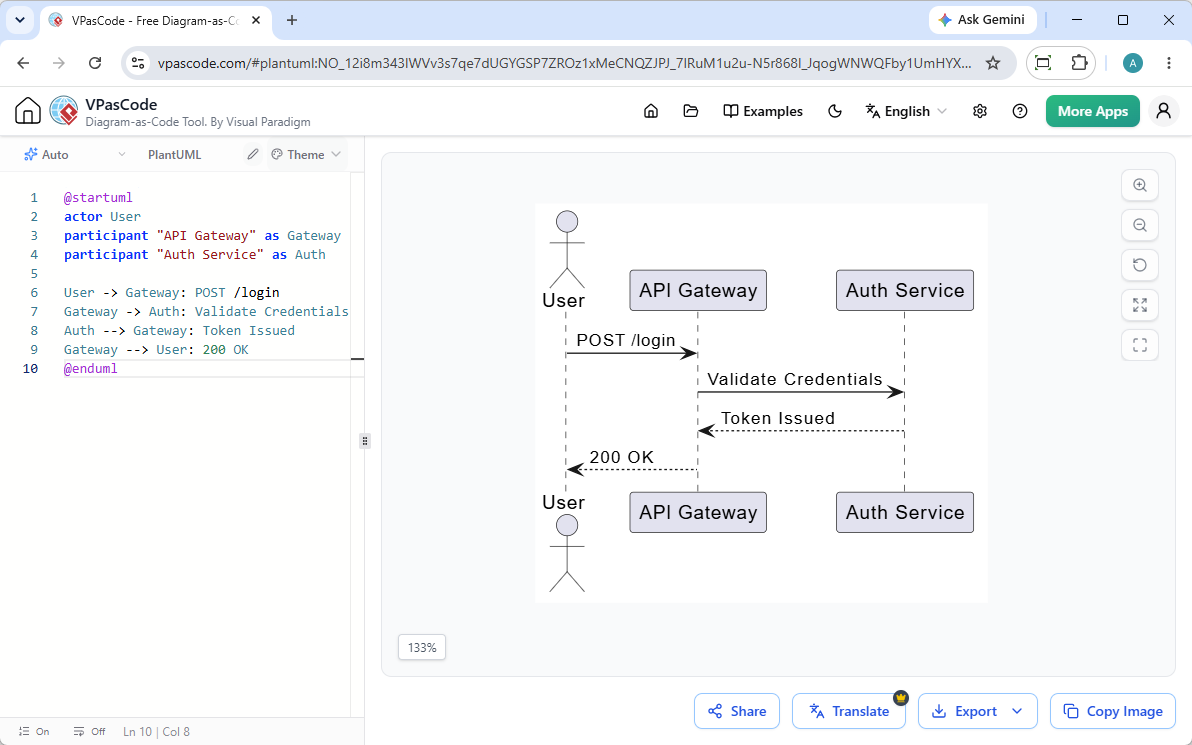
Mit domänenspezifischen Sprachen (DSLs) wie PlantUML, Mermaid oder D2 können Entwickler Beziehungen mit einfacher Syntax deklarieren:
@startuml
actor User
participant "API Gateway" as Gateway
participant "Auth Service" as Auth

User -> Gateway: POST /login
Gateway -> Auth: Validieren von Anmeldeinformationen
Auth --> Gateway: Token ausgestellt
Gateway --> User: 200 OK
@endumlDieser textbasierte Ansatz ermöglicht es, visuelle Dokumentation code-rezensiert, versioniert und so schnell wie der Code selbst bearbeitet zu werden.
2. Straffung multi-paradigmatischer Visualisierungen mit VPasCode
Bei der Arbeit über verschiedene Paradigmen hinweg kann die Verwaltung mehrerer lokaler Compiler und Syntax-Einrichtungen Reibungen verursachen. Visual Paradigm VPasCodebeseitigt diese Hürde, indem es einen einheitlichen Online-Editor für Diagramm als Code und einen Echtzeit-Renderer bereitstellt.
Egal, ob Sie PlantUML-Sequenzdiagramme für Microservices, Mermaid-Flussdiagramme für funktionale Pipelines oder Graphviz-Diagramme für Datenbankschemata erstellen – VPasCode bietet leistungsstarke Funktionen sofort einsatzbereit:
- Automatische Format-Erkennung:Fügen Sie rohen PlantUML-, Mermaid-, D2- oder Graphviz-Code ein – VPasCode erkennt die Sprache automatisch und rendert sie sofort.
- KI-gestützte Code-Korrektur:Syntaxfehler werden mithilfe der „Fix by AI”-Funktion sofort behoben.”„Fix by AIFunktion, einschließlich gegenübergestellter Code-Diffs, um Ihnen zu helfen, Syntax schneller zu erlernen.
- Eingebaute Übersetzung:Übersetzen Sie Diagrammbeschriftungen sofort in mehrere Sprachen direkt im Editor.
- Vektor-Export und Teilen:Exportieren Sie saubere SVG/PNG-Dateien oder teilen Sie dynamische URLs und QR-Codes direkt mit Ihrem Team.
Praktischer Leitfaden: Auswahl der richtigen UML-Diagramme für Nicht-OOP-Projekte
Um eine Überkonstruktion Ihrer visuellen Dokumentation zu vermeiden, wählen Sie Diagrammtypen basierend auf Ihrer primären Designherausforderung aus:
- Wenn Sie Geschäftslogik oder Workflows abbilden müssen:Verwenden Sie „UML-ER-Diagramme”.”Activity Diagrams oder „C4-ArchitekturdiagrammeMermaid-Flussdiagramme.
- Wenn Sie API-Endpunkte oder asynchrone Ereignisse detailliert beschreiben müssen:Verwenden Sie „UML-ER-Diagramme”.”Sequenzdiagramme.
- Wenn Sie Systembereitstellungen oder Cloud-Infrastrukturen modellieren müssen:Verwenden Sie „UML-ER-Diagramme”.”Bereitstellungsdiagramme oder „C4-ArchitekturdiagrammeC4-Architekturdiagramme.
- Wenn Sie relationale Schemata planen müssen:Verwenden Sie „UML-ER-Diagramme”.”UML-ER-Diagramme oder PlantUML-Klassendiagramme für Tabellen angepasst.
Häufig gestellte Fragen (FAQ)
Kann ich UML-Diagramme für funktionale Programmiersprachen wie Haskell oder Erlang verwenden?
Ja. Verhaltensbezogene UML-Diagramme (wie Sequenz- und Aktivitätsdiagramme) modellieren den Ausführungsfluss, Zustandsänderungen und die Ereignisbehandlung, unabhängig davon, ob der zugrunde liegende Code Klassen oder reine Funktionen verwendet.
Was ist der Unterschied zwischen UML- und ER-Diagrammen für die Datenbankmodellierung?
ER-Diagramme (Entity-Relationship) modellieren spezifisch Datenbankentitäten und -beziehungen. UML-Klassendiagramme bieten eine breitere Syntax, die Datenbanktabellen modellieren kann, während sie nahtlos auf Anwendungslogik und API-Verträge erweitert werden.
Wie ist der schnellste Weg, UML-Diagramme aus Textcode zu rendern?
Sie können einen kostenlosen Online-Editor ohne Einrichtung wie VPasCode verwenden. Dieser erkennt automatisch PlantUML-, Mermaid- und D2-Codeformate und rendert SVG/PNG-Bilder sofort in Ihrem Browser.
Probieren Sie VPasCode jetzt aus unter: https://www.vpascode.com/editor/
Related posts:
 Warum VPasCode die beste Software zum Bearbeiten von PlantUML ist (und wie andere im Vergleich abschneiden)
 Umfassender Leitfaden zu PlantUML-Sequenzdiagrammen: Syntax, Beispiele & Best Practices
 Welche Diagrammtypen können Sie mit PlantUML erstellen? (Vollständiger Leitfaden)
 Verwenden Softwareingenieure immer noch UML? Die ehrliche Realität & der moderne Wandel