


When architecting high-performance systems, memory-safe backend services, or command-line utilities in Rust, reading dense struct definitions and trait implementation blocks can make it difficult to visualize overall system architecture. The Rust Visualizer transforms Rust structs, enums, traits, and implementation blocks (impl) into clear, interactive diagram maps. By parsing data structures, trait contracts, and implementation networks, systems engineers and backend developers can visually inspect domain models and software architectures at a glance.
The Mechanics of Rust Visualizations
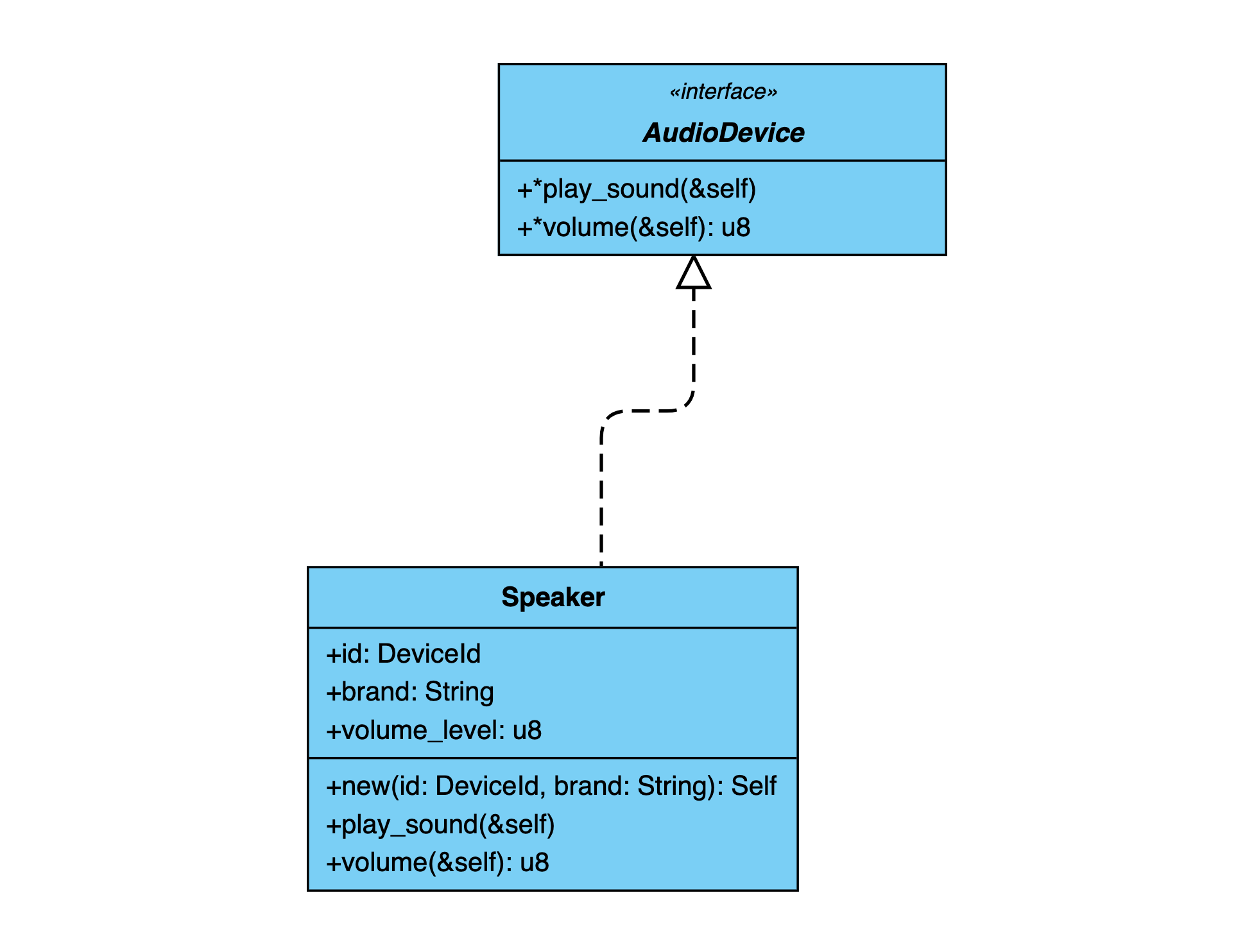
In VPasCode, Rust rendering automatically parses struct declarations, enum variants, trait definitions, and impl blocks into structured visual diagram cards. Structs and enums serve as primary entity blocks, field visibility (pub) displays access boundaries, and trait implementations (impl Trait for Type) automatically generate structural relationship lines between visual nodes.
1. Essential Setup
To visualize a standard Rust domain model, define traits, data structs, and trait implementation blocks. Standard object models like playable entities and audio devices demonstrate fundamental trait contracts and implementation relationships:
// Behavioral trait for audio devices
pub trait AudioDevice {
    fn play_sound(&self);
    fn volume(&self) -> u8;
}

// Custom type alias for identification
pub type DeviceId = String;

// Base struct representing a speaker
pub struct Speaker {
    pub id: DeviceId,
    pub brand: String,
    volume_level: u8,
}

impl Speaker {
    pub fn new(id: DeviceId, brand: String) -> Self {
        Self {
            id,
            brand,
            volume_level: 50,
        }
    }
}

impl AudioDevice for Speaker {
    fn play_sound(&self) {
        println!("Speaker {} playing audio", self.id);
    }

    fn volume(&self) -> u8 {
        this.volume_level
    }
}
Advanced Structural Techniques
Rust visualizations excel at mapping out rich algebraic data types (enums with data payloads), error handling mechanisms, and state machine patterns.
1. Network State and Algebraic Enums
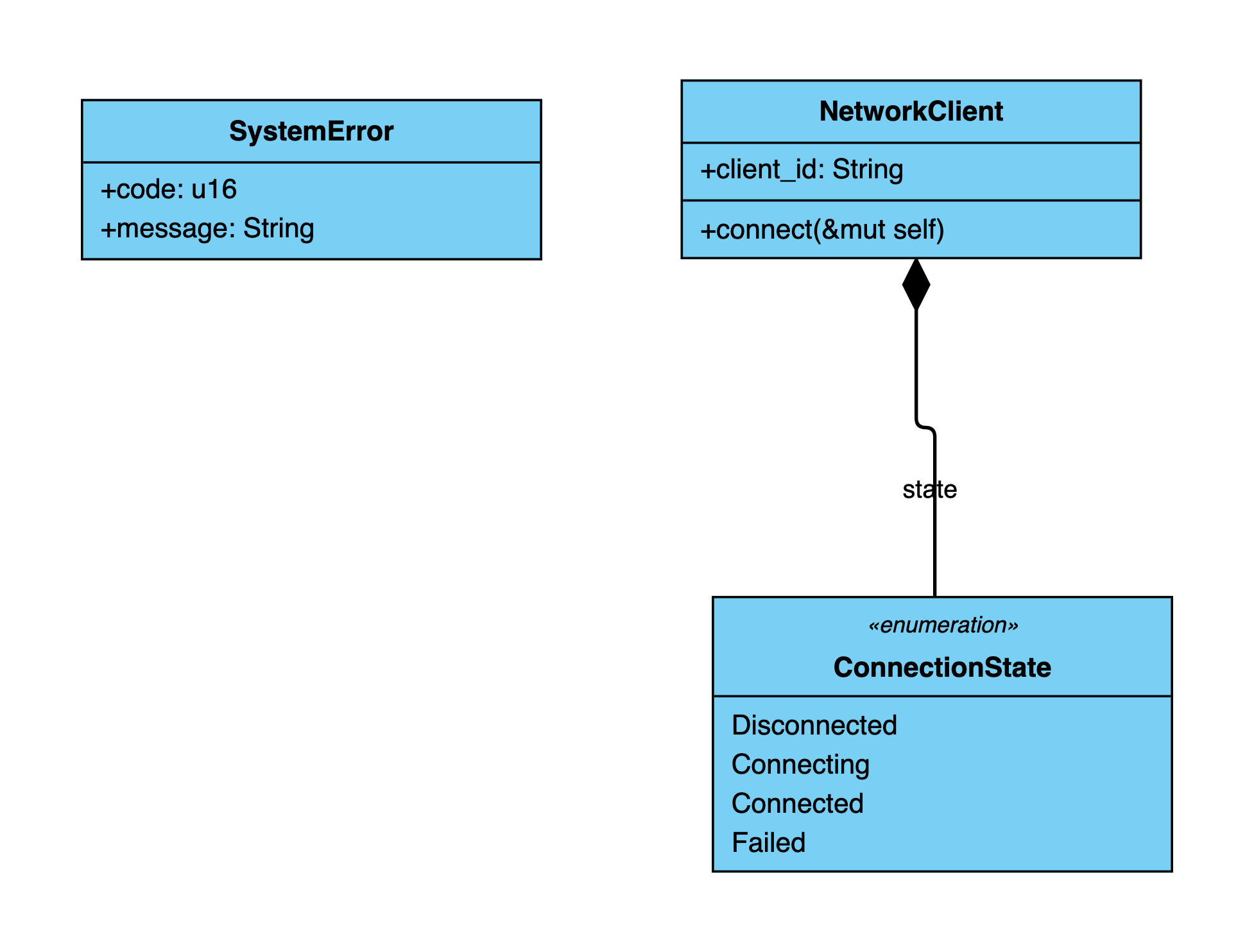
By combining enums with embedded struct tuples and custom state payload variants, VPasCode transforms complex Rust enums into readable node trees:
pub enum ConnectionState {
    Disconnected,
    Connecting { attempts: u32 },
    Connected(String), // Contains active IP address
    Failed(SystemError),
}

pub struct SystemError {
    pub code: u16,
    pub message: String,
}

pub struct NetworkClient {
    pub client_id: String,
    pub state: ConnectionState,
}

impl NetworkClient {
    pub fn connect(&mut self) {
        self.state = ConnectionState::Connecting { attempts: 1 };
    }
}
Structuring Generic Repositories and Asynchronous Storage
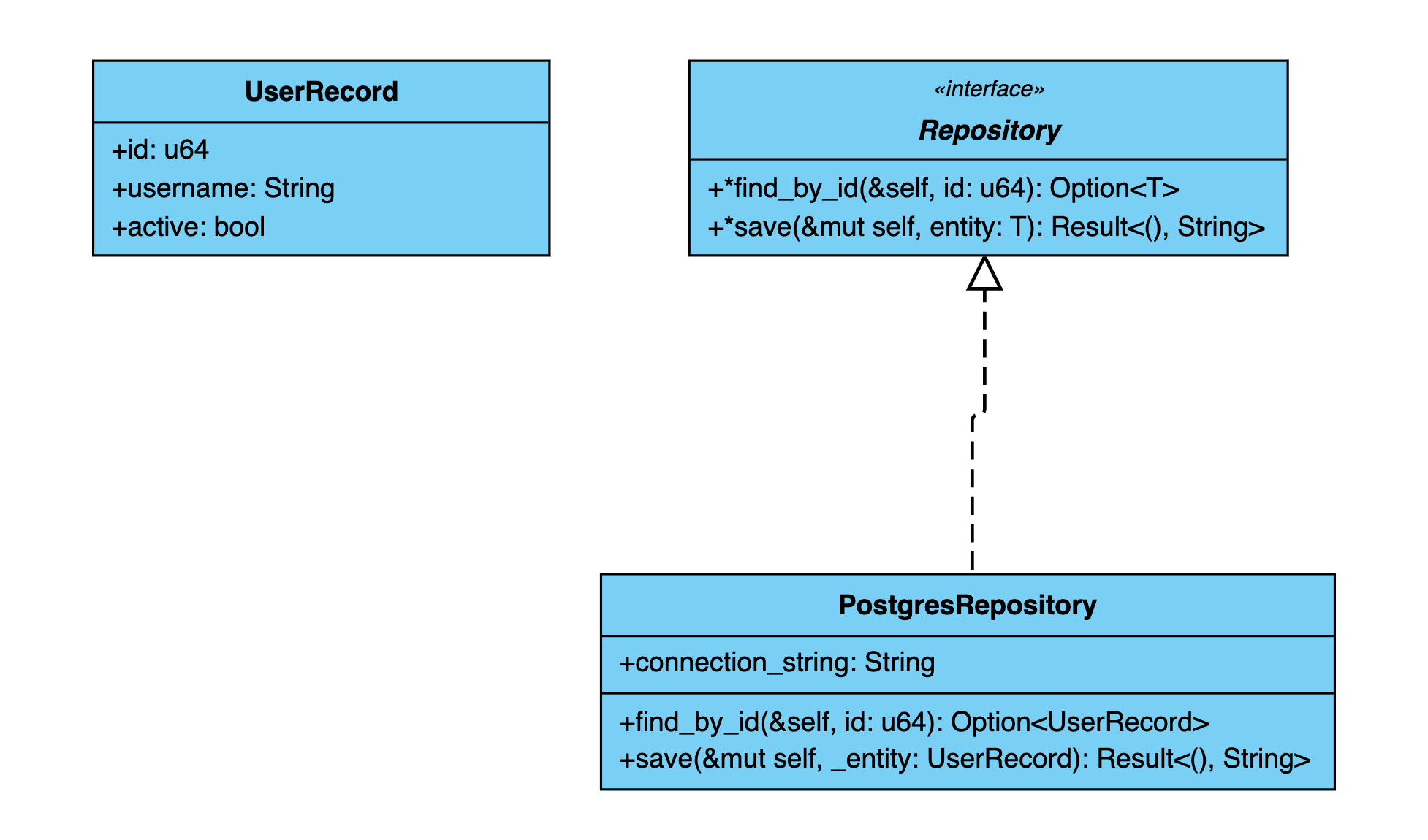
Visualizing generic trait bounds (T: Storage), async service structures, and data repositories helps teams design modular, loosely coupled Rust applications.
1. Generic Storage Repository Model
Group asynchronous storage traits, record models, and database implementation structs to map clear abstraction boundaries:
pub struct UserRecord {
    pub id: u64,
    pub username: String,
    pub active: bool,
}

pub trait Repository<T> {
    fn find_by_id(&self, id: u64) -> Option<T>;
    fn save(&mut self, entity: T) -> Result<(), String>;
}

pub struct PostgresRepository {
    pub connection_string: String,
}

impl Repository<UserRecord> for PostgresRepository {
    fn find_by_id(&self, id: u64) -> Option<UserRecord> {
        Some(UserRecord {
            id,
            username: String::from("alice"),
            active: true,
        })
    }

    fn save(&mut self, _entity: UserRecord) -> Result<(), String> {
        Ok(())
    }
}
Strategic Best Practices
- Use Traits for Shared Behavior: Define behavioral contracts using
traitconstructs and implement them explicitly withimpl Trait for Typeto keep visual relationships clear. - Leverage Rich Enums for State Representation: Represent distinct domain states using Rust enums with tuple or struct variants rather than multiple boolean flags.
- Mark Public Fields Explicitly: Use
pubon fields and methods intended for external use so module access boundaries reflect accurately on diagram cards.