


When transmitting structured data to Large Language Models (LLMs) or parsing compact context payloads, traditional JSON syntax contains significant overhead due to mandatory quotes, braces, and repetitive keys. The TOON Visualizer transforms Token-Oriented Object Notation (TOON) into clean, interactive tree-structured node graphs. By converting indentation-based nesting and CSV-style tabular array declarations into visual trees, developers and prompt engineers can inspect token-optimized payloads without sacrificing data clarity.
The Mechanics of TOON Visualizations
In VPasCode, TOON rendering automatically parses whitespace-indented fields, primitive values, and array length/schema headers into structured visual trees. Keys serve as parent nodes, tab or space indentations dictate tree hierarchy, and explicit array declarations parse directly into clear child branches or tabular data rows.
1. Essential Setup
To visualize a standard TOON document, define object fields using YAML-like key-value pairs without quotes, braces, or trailing commas:
service: authentication-api
version: 1.4.0
active: true

network:
  port: 8080
  host: localhost
  protocols[2]: http,https
Advanced Structural Techniques
TOON visualizations excel at rendering tabular arrays of objects, combining CSV-like efficiency with explicit schema headers.
1. Uniform Tabular Arrays
By declaring the array length and property fields in the header tag (e.g., users[2]{id,name,role}:), VPasCode parses each tabular row into explicit node trees without needing repeating object keys:
organization: TechCorp
department: Engineering

users[2]{id,name,role}:
  1,Alice,admin
  2,Bob,developer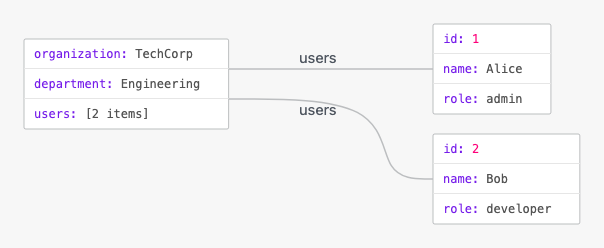
Structuring Multi-Level Workspaces
Using TOON for LLM system prompts and context injection allows multi-tiered datasets to remain readable while saving 30% to 50% in token costs.
1. Nested System Context
Group environment flags, model parameters, and tabular feature sets into clean indented sub-blocks for visual evaluation:
modelConfig:
  provider: anthropic
  temperature: 0.2

features[3]{name,enabled,tier}:
  search,true,free
  analytics,true,pro
  apiAccess,false,enterprise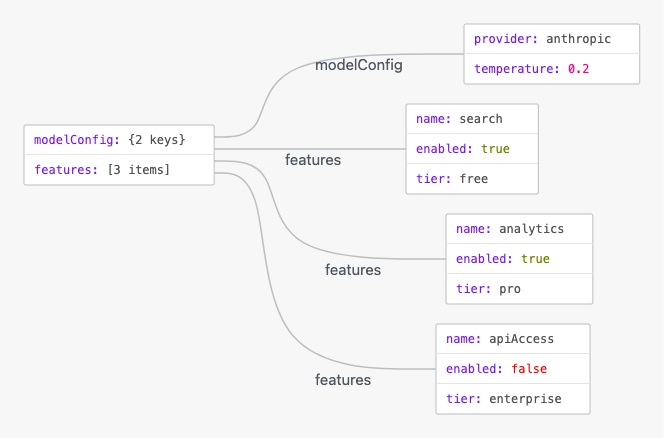
Strategic Best Practices
- Use Tabular Declarations for Uniform Arrays: Define array size and field keys in the block header (such as
items[N]{field1,field2}:) to maximize token savings. - Maintain Consistent Indentation: Rely on clean 2-space or tab indentation to represent nested child objects without curly braces.
- Quote Strings Only When Required: Omit quotation marks around plain strings, reserving quotes for strings containing active delimiters, colons, or leading/trailing spaces.