


When building high-performance graphics engines, embedded software, or core systems in C++, navigating complex class hierarchies and header declarations can quickly become overwhelming. The C++ Visualizer transforms C++ class definitions, structs, abstract base interfaces, and inheritance chains into clear, interactive class diagrams. By parsing class members, access specifiers (public, protected, private), virtual methods, and inheritance linkages, systems programmers and software architects can visually inspect object-oriented architecture and memory ownership models at a glance.
The Mechanics of C++ Visualizations
In VPasCode, C++ rendering automatically parses class and struct declarations, access sections, virtual function contracts, and inheritance specifications into structured UML-style diagrams. Classes serve as main entity cards, access specifiers dictate field and method visibility groups, and inheritance keywords (including multiple inheritance) generate distinct relationship connectors between class nodes.
1. Essential Setup
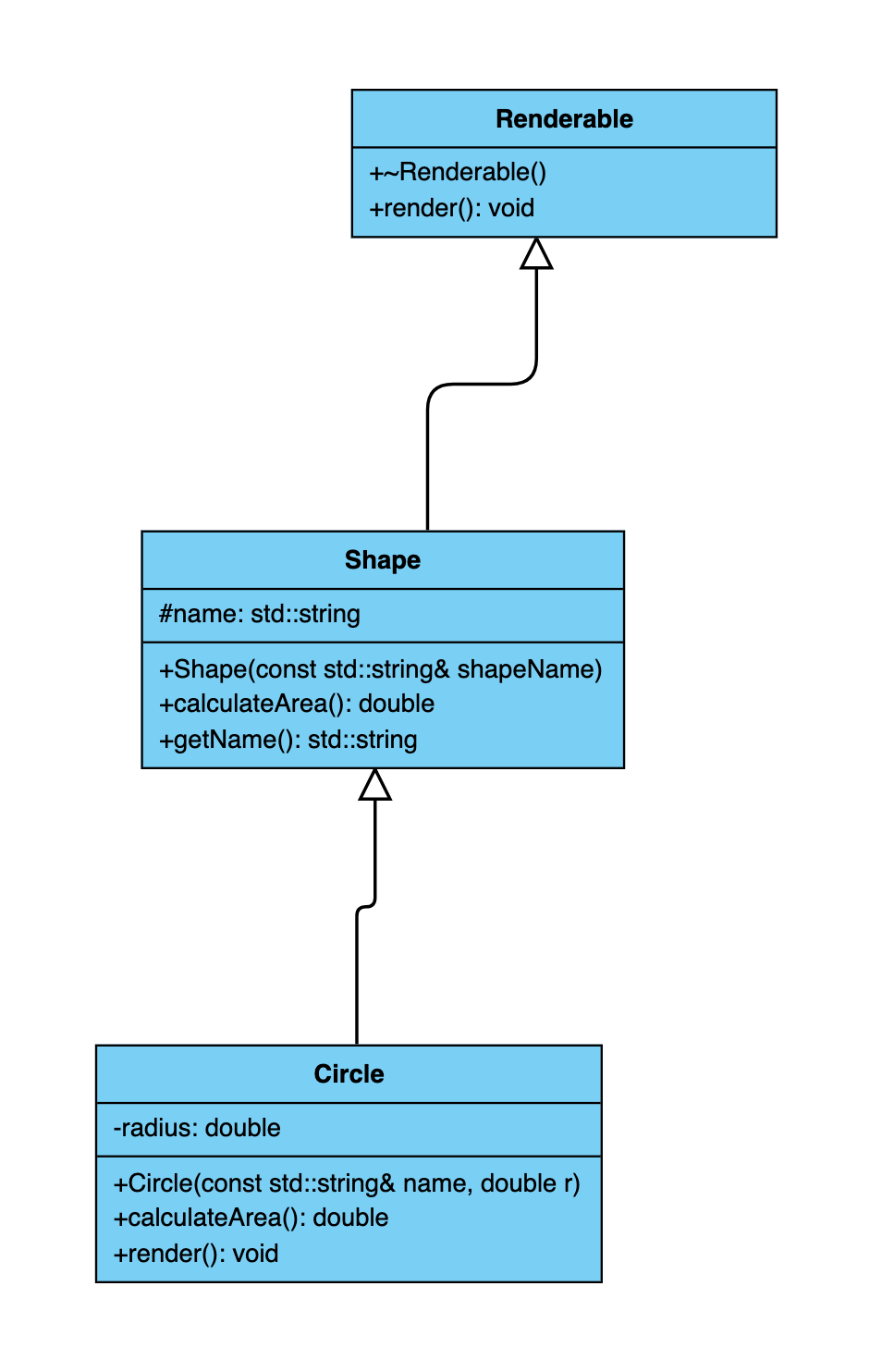
To visualize a standard C++ class hierarchy, define abstract base classes with pure virtual functions (= 0) alongside derived class implementations. Standard object hierarchies like geometric shapes or renderable objects demonstrate fundamental class relationships:
#pragma once
#include <iostream>
#include <string>

// Abstract base interface
class Renderable {
public:
    virtual ~Renderable() = default;
    virtual void render() const = 0;
};

// Base class for geometric shapes
class Shape : public Renderable {
protected:
    std::string name;

public:
    Shape(const std::string& shapeName) : name(shapeName) {}

    virtual double calculateArea() const = 0;

    std::string getName() const {
        return name;
    }
};

// Derived concrete circle class
class Circle : public Shape {
private:
    double radius;

public:
    Circle(const std::string& name, double r)
        : Shape(name), radius(r) {}

    double calculateArea() const override {
        return 3.14159 * radius * radius;
    }

    void render() const override {
        std::cout << "Rendering circle: " << name << std::endl;
    }
};
Advanced Structural Techniques
C++ visualizations excel at exposing multi-inheritance topologies, mixin patterns, and hardware driver abstractions.
1. Multiple Inheritance and Hardware Interfaces
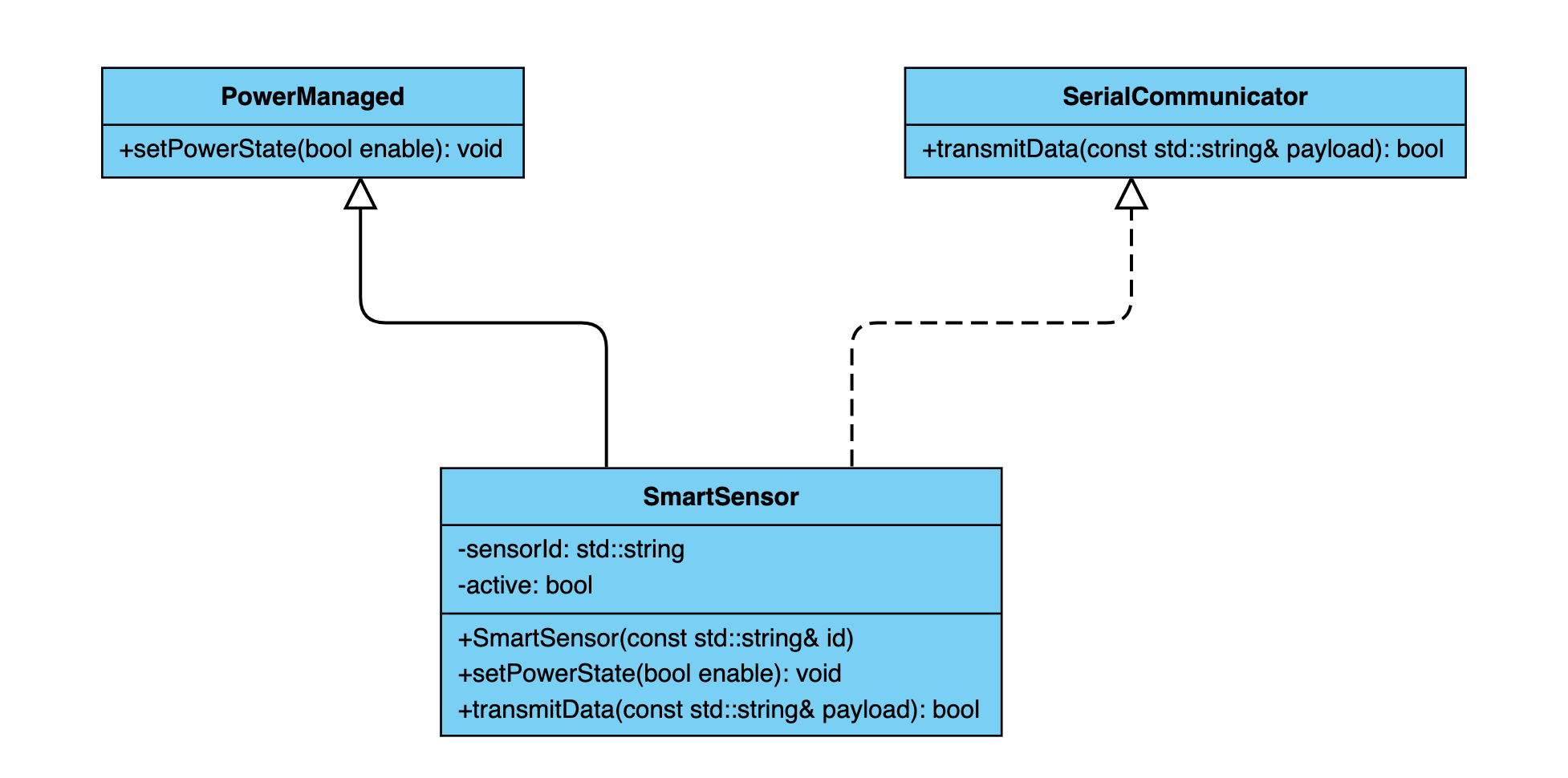
By combining multiple interface bases (such as power management and data transmission) into a single concrete device class, VPasCode transforms complex C++ multiple inheritance structures into clear node networks:
class PowerManaged {
public:
    virtual void setPowerState(bool enable) = 0;
};

class SerialCommunicator {
public:
    virtual bool transmitData(const std::string& payload) = 0;
};

// Concrete device utilizing multiple inheritance
class SmartSensor : public PowerManaged, public SerialCommunicator {
private:
    std::string sensorId;
    bool active;

public:
    SmartSensor(const std::string& id) : sensorId(id), active(false) {}

    void setPowerState(bool enable) override {
        active = enable;
    }

    bool transmitData(const std::string& payload) override {
        if (!active) return false;
        std::cout << "[" << sensorId << "] Transmitting: " << payload << std::endl;
        return true;
    }
};
Structuring Game Entities and Component Systems
Visualizing entity-component systems (ECS), game actors, and engine subsystem managers helps game developers maintain clean decoupling and clear memory access paths.
1. Game Entity and Component Architecture
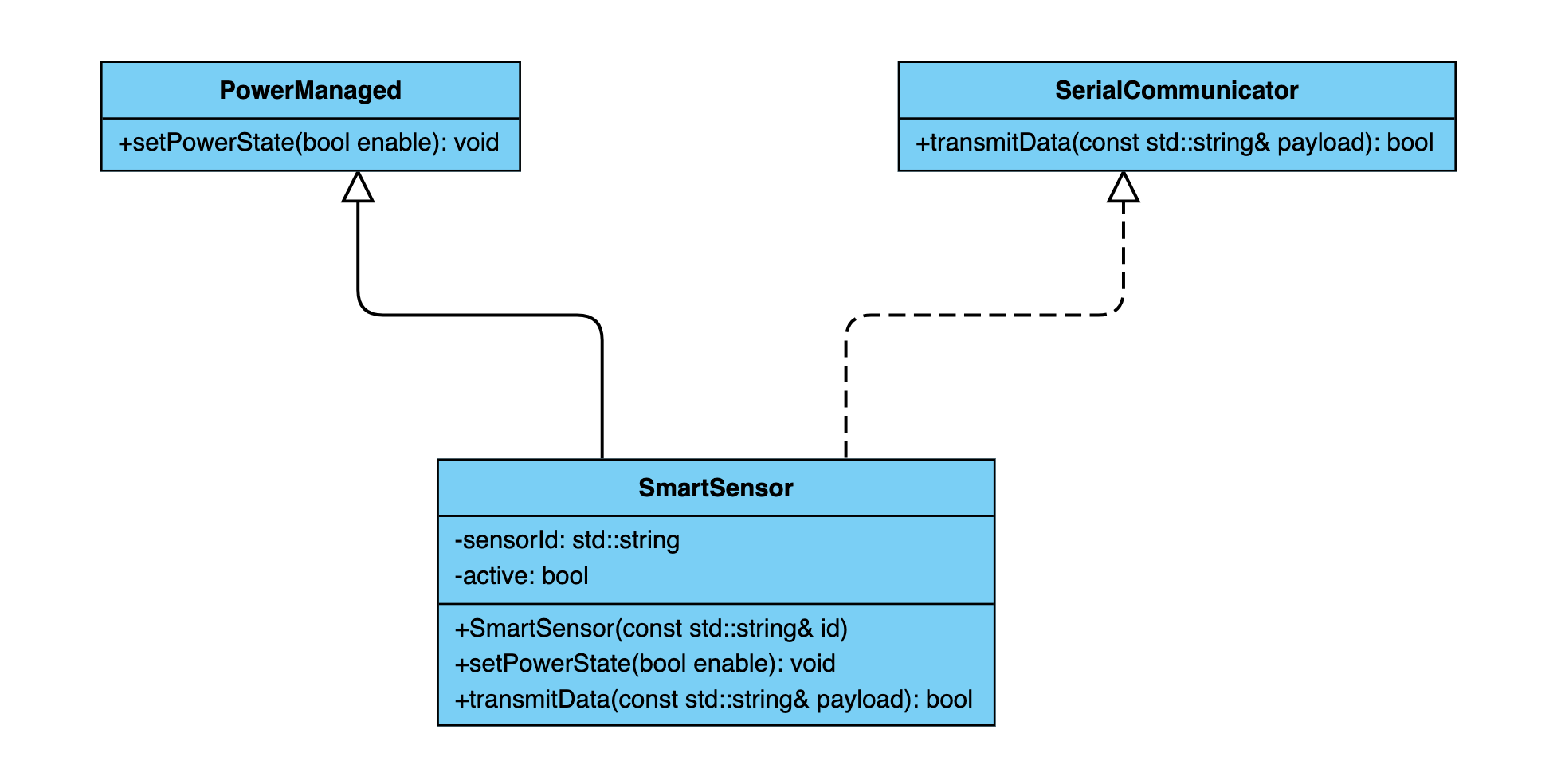
Group base game actors, component pointer collections, and spatial transform structures to map out core engine object relationships:
struct Vector3 {
    float x{0.0f};
    float y{0.0f};
    float z{0.0f};
};

class Component {
public:
    virtual void update(float deltaTime) = 0;
};

class Actor {
protected:
    uint64_t entityId;
    Vector3 position;

public:
    Actor(uint64_t id) : entityId(id) {}
    virtual void tick(float deltaTime) = 0;
};

class PlayerCharacter : public Actor {
private:
    float health{100.0f};
    Component* movementComponent{nullptr};

public:
    PlayerCharacter(uint64_t id) : Actor(id) {}

    void tick(float deltaTime) override {
        if (movementComponent) {
            movementComponent->update(deltaTime);
        }
    }
};
Strategic Best Practices
- Organize Members by Access Specifiers: Group fields and methods under explicit
public:,protected:, andprivate:specifiers to keep diagram cards neatly compartmentalized. - Mark Virtual Overrides Explicitly: Always use the
overridekeyword on virtual function implementations to highlight polymorphic behaviors clearly. - Leverage Structs for Plain Data: Use
structfor lightweight data containers (where default member access is public) and reserveclassfor encapsulated domain entities.