


When architecting fault-tolerant, concurrent applications or distributed systems in Elixir, navigating module boundaries, struct contracts, behaviors, and OTP supervisor trees can make it difficult to picture overall system architecture. The Elixir Visualizer transforms Elixir modules, struct definitions (defstruct), type specifications (@type), and behavior contracts (@callback) into clear, interactive architectural diagrams. By parsing data contracts, pattern-matched function signatures, and module dependencies, Elixir developers and system architects can visually inspect functional domain models and OTP application layouts at a glance.
The Mechanics of Elixir Visualizations
In VPasCode, Elixir rendering automatically parses defmodule definitions, defstruct declarations, type specifications (@type), and behavior callbacks (@callback) into structured diagram cards. Modules render as primary entity blocks, struct fields display access specifications and default values, and module behaviors or usage contracts generate direct relationship lines between visual nodes.
1. Essential Setup
To visualize a standard Elixir module architecture, define behavior contracts alongside structs and module implementations. A distributed telemetry monitoring service demonstrates fundamental Elixir behaviors and struct definitions:
defmodule Telemetry.Reporter do
  @doc "Behavior contract for metric reporters"
  @callback report_metric(metric_name :: String.t(), value :: number()) :: :ok | {:error, term()}
end

defmodule Telemetry.Event do
  @type t :: %__MODULE__{
          id: String.t(),
          name: String.t(),
          value: number(),
          timestamp: DateTime.t()
        }

  defstruct [:id, :name, :value, :timestamp]

  @spec new(String.t(), number()) :: t()
  def new(name, value) do
    %__MODULE__{
      id: "evt_" <> Integer.to_string(System.unique_integer([:positive])),
      name: name,
      value: value,
      timestamp: DateTime.utc_now()
    }
  end
end

defmodule Telemetry.ConsoleReporter do
  @behaviour Telemetry.Reporter

  @impl Telemetry.Reporter
  def report_metric(metric_name, value) do
    IO.puts("[METRIC] #{metric_name}: #{value}")
    :ok
  end
end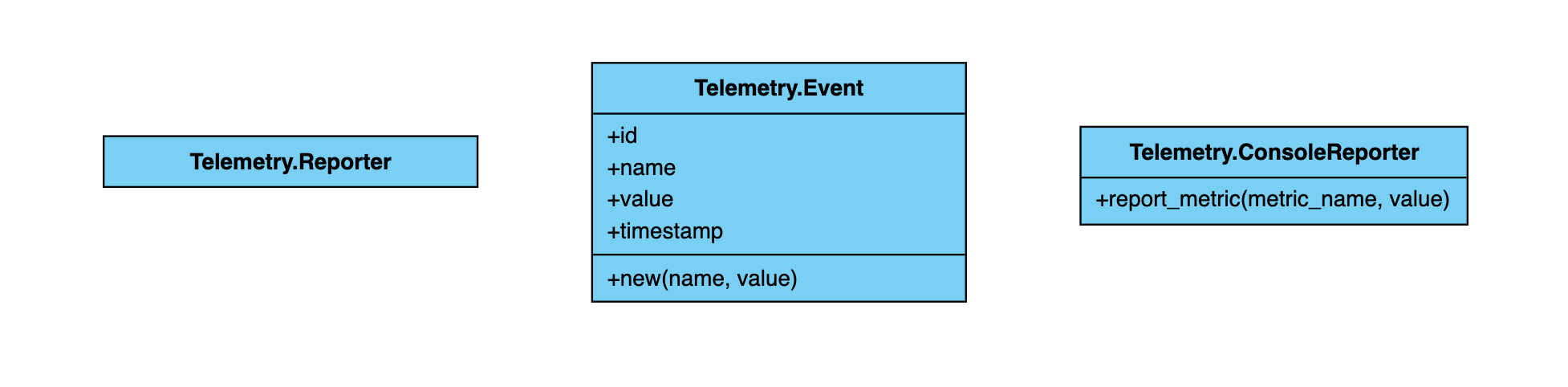
Advanced Structural Techniques
Elixir visualizations excel at mapping out functional domain models, immutable shopping cart aggregates, and pattern-matched state transitions.
1. E-Commerce Cart & Checkout Domain
By combining value structs, type specifications, and functional domain modules, VPasCode transforms Elixir functional domain layers into clean, structured diagram networks:
defmodule Store.CartItem do
  @type t :: %__MODULE__{
          sku: String.t(),
          unit_price: Decimal.t(),
          quantity: pos_integer()
        }

  defstruct [:sku, :unit_price, quantity: 1]
end

defmodule Store.ShoppingCart do
  alias Store.CartItem

  @type t :: %__MODULE__{
          id: String.t(),
          customer_id: String.t(),
          items: list(CartItem.t()),
          status: :active | :checked_out
        }

  defstruct [:id, :customer_id, items: [], status: :active]

  @spec add_item(t(), CartItem.t()) :: t()
  def add_item(%__MODULE__{status: :active} = cart, %CartItem{} = item) do
    %{cart | items: [item | cart.items]}
  end

  @spec checkout(t()) :: {:ok, t()} | {:error, String.t()}
  def checkout(%__MODULE__{status: :active, items: [_ | _]} = cart) do
    {:ok, %{cart | status: :checked_out}}
  end

  def checkout(_cart), do: {:error, "Cannot checkout empty or inactive cart"}
end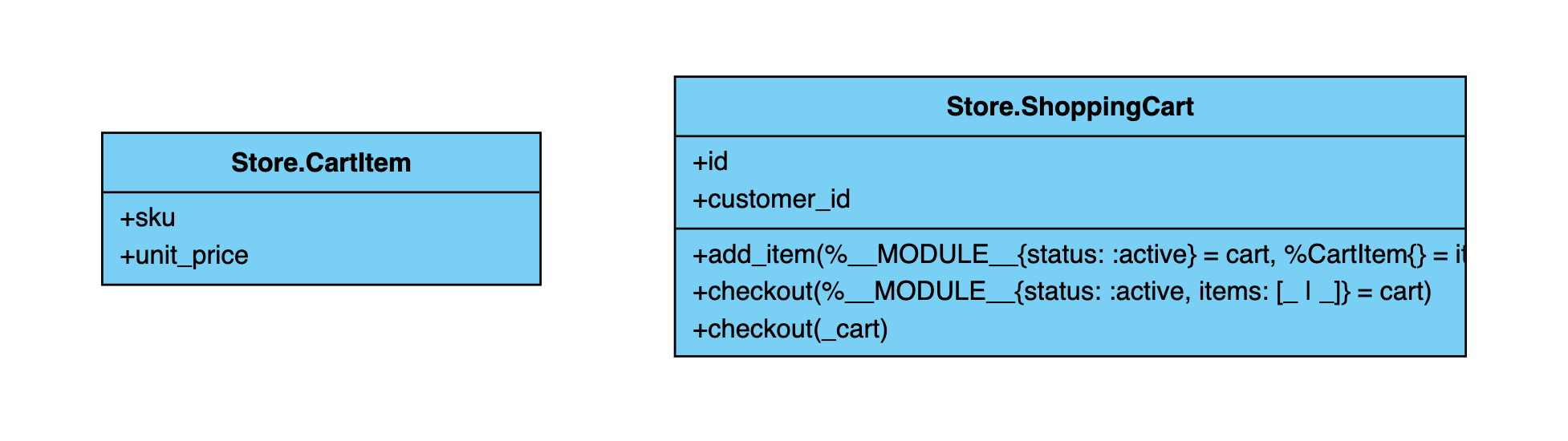
Structuring OTP GenServer Workers and Supervisor Pipelines
Visualizing OTP GenServer client APIs, server state structs, and supervision trees helps Elixir teams design fault-tolerant, resilient concurrent backend services.
1. OTP GenServer Queue Worker
Group client API functions, GenServer callbacks, and internal state structs to map out concurrent worker boundaries:
defmodule ProcessingQueue.Worker do
  use GenServer

  defmodule State do
    @type t :: %__MODULE__{
            queue: list(term()),
            active_jobs: non_neg_integer()
          }
    defstruct queue: [], active_jobs: 0
  end

  # Client API
  def start_link(opts) do
    GenServer.start_link(__MODULE__, opts, name: __MODULE__)
  end

  def push_job(job) do
    GenServer.cast(__MODULE__, {:push, job})
  end

  # Server Callbacks
  @impl GenServer
  def init(_opts) do
    {:ok, %State{}}
  end

  @impl GenServer
  def handle_cast({:push, job}, %State{queue: queue} = state) do
    updated_queue = queue ++ [job]
    {:noreply, %{state | queue: updated_queue}}
  end
end
Strategic Best Practices
- Use
defstructfor Domain Models: Declare explicit structs with default values so entity properties are cleanly represented on visual node cards. - Leverage
@behaviourfor Contracts: Define reusable module interfaces using@callbackdefinitions to keep functional abstractions visible. - Annotate Types with
@type: Include explicit type specifications for struct fields and function parameters to ensure clear parameter signatures in diagrams.