


When architecting complex front-end applications, domain models, or backend services, reading dense TypeScript source code can make it difficult to visualize type contracts and class hierarchies. The TypeScript Visualizer transforms TypeScript interface declarations, custom type aliases, generic models, and class structures into clear, interactive class and type diagrams. By parsing type definitions, access modifiers (public, private, readonly), and inheritance networks (extends, implements), developers and software architects can visually inspect type safety and object-oriented designs at a glance.
The Mechanics of TypeScript Visualizations
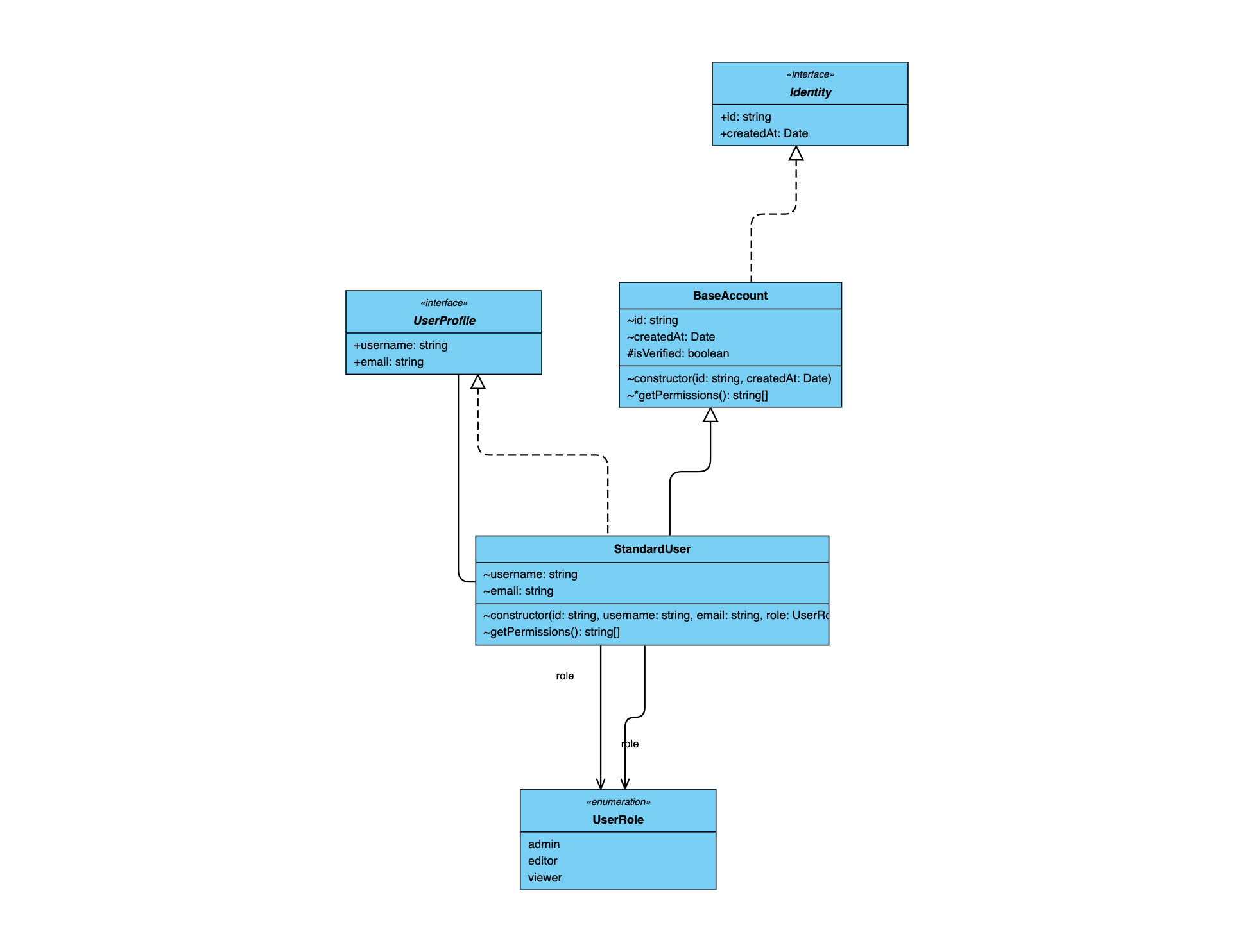
In VPasCode, TypeScript rendering automatically parses interfaces, custom type aliases, generic boundaries, classes, and class members into structured visual UML-style diagrams. Interfaces and type aliases serve as structural contract nodes, classes render as entity blocks with typed field members, and inheritance or interface implementation keywords generate clear relationship connectors between visual nodes.
1. Essential Setup
To visualize a standard TypeScript type system, define interfaces, type aliases, and implementing classes. Standard domain models like user accounts and roles demonstrate fundamental type contracts and class relationships:
// User identity and permissions model
export type UserRole = 'admin' | 'editor' | 'viewer';

export interface Identity {
  readonly id: string;
  createdAt: Date;
}

export interface UserProfile extends Identity {
  username: string;
  email: string;
  role: UserRole;
}

export abstract class BaseAccount implements Identity {
  readonly id: string;
  createdAt: Date;
  protected isVerified: boolean = false;

  constructor(id: string, createdAt: Date) {
    this.id = id;
    this.createdAt = createdAt;
  }

  abstract getPermissions(): string[];
}

export class StandardUser extends BaseAccount implements UserProfile {
  username: string;
  email: string;
  role: UserRole;

  constructor(id: string, username: string, email: string, role: UserRole) {
    super(id, new Date());
    this.username = username;
    this.email = email;
    this.role = role;
  }

  getPermissions(): string[] {
    return ['read', 'comment'];
  }
}
Advanced Structural Techniques
TypeScript visualizations excel at mapping out generic data pipelines, API response wrappers, and state management interfaces.
1. Generic API Data Response Model
By combining generic type interfaces () with status unions and error payload structures, VPasCode transforms complex type contracts into readable node networks:
export type ResponseStatus = 'success' | 'error' | 'pending';

export interface ApiError {
  code: number;
  message: string;
  details?: Record<string, string>;
}

export interface ApiResponse {
  status: ResponseStatus;
  data: T | null;
  error?: ApiError;
  timestamp: number;
}

export interface Product {
  id: string;
  title: string;
  price: number;
  inStock: boolean;
}

export class ProductService {
  private apiUrl: string = 'https://api.example.com/v1/products';

  async fetchProduct(id: string): Promise<ApiResponse> {
    return {
      status: 'success',
      data: { id, title: 'Wireless Headphones', price: 99.99, inStock: true },
      timestamp: Date.now(),
    };
  }
}
Structuring Event-Driven Workflows and Observers
Visualizing event handlers, payload interfaces, and listener classes helps frontend and full-stack engineering teams maintain clear decoupling across event-driven architectures.
1. Event Emitter and Payload Handler System
Define typed event interfaces and subscriber classes to map out reactive state architectures and messaging abstractions:
export interface SystemEvent {
  eventName: string;
  payload: TPayload;
  occurredAt: Date;
}

export interface OrderPayload {
  orderId: string;
  total: number;
}

export interface EventObserver {
  onEvent(event: SystemEvent): void;
}

export class NotificationService implements EventObserver {
  onEvent(event: SystemEvent): void {
    console.log(`Notification sent for order: ${event.payload.orderId}`);
  }
}
Strategic Best Practices
- Use Interfaces for Public API Contracts: Define object shapes and public interfaces with
interfaceso classes can useimplementsfor clear visual linkage. - Leverage Explicit Access Modifiers: Always mark class properties as
public,private,protected, orreadonlyto keep access levels transparent in rendered diagram cards. - Keep Generic Bounds Clear: Use descriptive type parameters (such as
or) rather than single letters when defining complex nested interfaces.